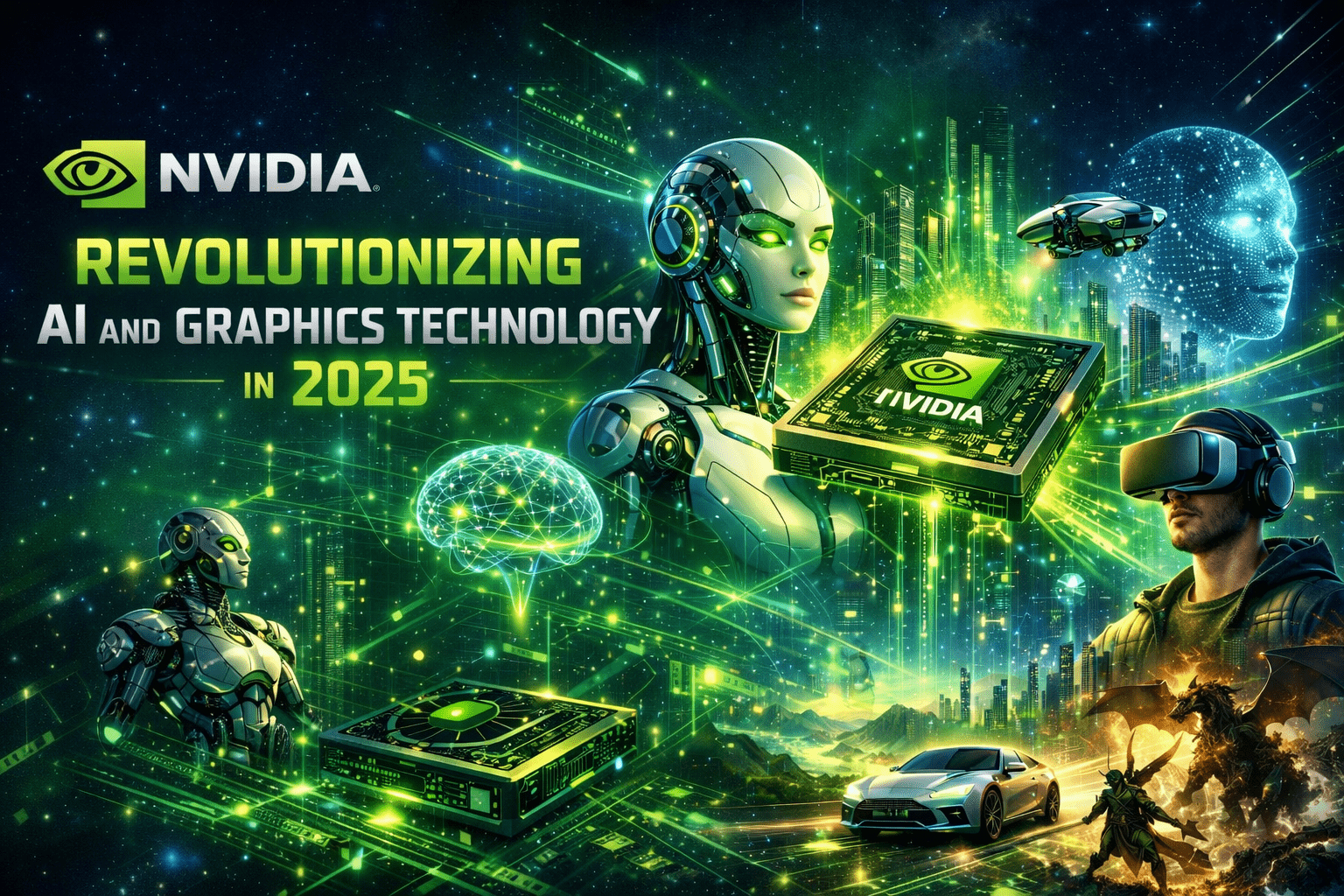
Nvidia: Revolutionizing AI and Graphics Technology in 2025
As we approach the end of 2025, Nvidia continues to assert its dominance in the technology landscape, particularly in the realms of artificial intelligence (AI) and graphics processing. The company’s innovative hardware and software solutions have not only transformed gaming but have also played a critical role in various sectors, including healthcare, automotive, and cloud computing. This deep dive examines Nvidia’s journey, its current innovations, and the future it is shaping.
The Evolution of Nvidia: A Historical Overview
Nvidia was founded in 1993 by Jensen Huang, Chris Malachowsky, and Curtis Priem, initially focusing on graphics processing units (GPUs). Over the years, the company has evolved from a niche player in the gaming market to a powerhouse in AI and deep learning. Its groundbreaking products, such as the GeForce series, have set industry standards for graphics performance.
In the early 2000s, Nvidia began to pivot from solely gaming to broader applications, recognizing the potential of GPUs in parallel processing. This shift was pivotal as it laid the groundwork for the company’s future in AI. The introduction of the CUDA programming model in 2006 allowed developers to utilize Nvidia GPUs for general-purpose computing tasks, further expanding its market reach.
Fast forward to 2025, Nvidia has positioned itself at the forefront of AI technology, with its GPUs serving as the backbone for machine learning algorithms and data analytics. The acquisition of Mellanox Technologies in 2020 and ARM Holdings in 2021 (though ultimately not completed) showcased Nvidia’s ambitions to dominate not just in graphics but in the entire data center ecosystem.
This historical context is crucial for understanding how Nvidia has maintained its competitive edge. The company’s relentless focus on R&D has yielded innovative products that cater to both consumer and enterprise needs, setting the stage for its current advancements in AI and machine learning.
Nvidia’s Current Innovations in AI and Machine Learning
Nvidia’s commitment to AI innovation is evident in its latest product lines, particularly the A100 and H100 Tensor Core GPUs. These GPUs are designed specifically for training and inference in deep learning models, providing unparalleled performance. The A100, for instance, can deliver up to 20 times the performance of its predecessors, significantly accelerating AI research and deployment.
The company’s software ecosystem, including Nvidia CUDA, TensorRT, and the Nvidia Deep Learning SDK, complements its hardware capabilities. Developers can leverage these tools to build sophisticated AI applications ranging from natural language processing to computer vision. In 2025, Nvidia’s software offerings are more robust than ever, with continuous updates and community support fostering innovation.
One of the standout innovations from Nvidia is the Omniverse platform, which allows creators to collaborate in real-time within 3D simulations. This platform has applications across various industries, including gaming, architecture, and film production. By enabling seamless collaboration and visualization, Omniverse is redefining how digital content is created and shared.
Nvidia’s foray into generative AI, particularly through tools like the Nvidia GauGAN, showcases its ability to push boundaries in creative fields. This tool allows users to create photorealistic images from simple sketches, illustrating the potential of AI in the creative process.
Moreover, Nvidia’s partnership with cloud service providers has made its AI solutions accessible to a broader audience. By integrating Nvidia’s technology into major cloud platforms, businesses can harness AI capabilities without the need for significant upfront investment in hardware.
The Impact of Nvidia on Gaming and Entertainment
The gaming industry has been transformed by Nvidia’s innovations, particularly with the introduction of real-time ray tracing and AI-driven enhancements. The company’s RTX graphics cards, powered by the Ampere architecture, have set new benchmarks for visual fidelity and performance. By simulating realistic lighting and reflections, Nvidia has elevated the gaming experience, providing gamers with immersive environments that were once thought impossible.
In 2025, the gaming landscape is more competitive than ever, with Nvidia leading the charge in pushing graphical capabilities. The integration of AI in gaming not only enhances graphics but also improves gameplay mechanics, such as adaptive AI that adjusts to player behavior. This results in a more personalized and engaging gaming experience.
Nvidia’s G-SYNC technology further enhances the gaming experience by eliminating screen tearing and ensuring smooth gameplay. As competitive gaming continues to grow, features like these are essential for gamers seeking an edge in performance.
The company’s influence extends beyond traditional gaming, as it has ventured into cloud gaming services, with platforms like GeForce NOW allowing gamers to play high-end titles on low-spec devices. This democratization of gaming is changing how games are consumed, making high-quality gaming more accessible to a diverse audience.
Moreover, Nvidia’s collaboration with game developers ensures that new titles are optimized for their hardware, further solidifying their position in the industry. As the boundaries between gaming and other forms of entertainment blur, Nvidia is at the forefront of this evolution, driving innovation across platforms.
Nvidia’s Role in the Future of Autonomous Vehicles
Nvidia’s contributions to the automotive industry, particularly in the realm of autonomous vehicles, cannot be overstated. The company’s DRIVE platform combines hardware and software solutions to enable self-driving capabilities in vehicles. As of 2025, Nvidia’s technology is embedded in numerous vehicles, from passenger cars to commercial fleets.
The DRIVE AGX platform serves as the brain of autonomous vehicles, processing vast amounts of data from sensors and cameras in real-time. This capability is crucial for the safe navigation of self-driving systems. Nvidia’s comprehensive approach includes not only the hardware but also the development of simulation tools that allow manufacturers to test autonomous systems in virtual environments, significantly reducing the time and cost associated with real-world testing.
In collaboration with major automotive manufacturers, Nvidia continues to refine its technology, ensuring that it meets the evolving demands of the industry. The push towards electric vehicles (EVs) further aligns with Nvidia’s vision, as EVs require advanced computing capabilities for efficiency and performance.
Moreover, Nvidia’s work in AI-powered driver assistance systems enhances vehicle safety, reducing accidents and improving overall driving experiences. As legislation and public acceptance of autonomous vehicles evolve, Nvidia is well-positioned to lead this transformation, making significant strides towards a future where self-driving cars are a reality.
Future Outlook: Challenges and Opportunities for Nvidia
As 2025 draws to a close, Nvidia faces both significant challenges and remarkable opportunities. The semiconductor industry is experiencing a paradigm shift, with supply chain disruptions and geopolitical tensions affecting production capabilities. Despite these challenges, Nvidia’s strategic investments in manufacturing and partnerships with foundries position it to navigate these turbulent waters effectively.
The rise of competitors, particularly in the AI and GPU markets, presents another challenge for Nvidia. Companies like AMD and Intel are making strides in developing competitive products, pushing Nvidia to continuously innovate and refine its offerings. However, Nvidia’s strong brand recognition and established ecosystem give it a competitive advantage that is hard to replicate.
Moreover, as AI becomes increasingly integrated into various sectors, Nvidia has the opportunity to expand its influence beyond gaming and automotive. Industries such as healthcare, finance, and education are leveraging AI for improved efficiency and decision-making, creating new markets for Nvidia’s technology.
Furthermore, sustainability is becoming a critical focus for tech companies, and Nvidia’s commitment to reducing its carbon footprint and promoting energy-efficient technologies aligns with global sustainability goals. As consumers and businesses increasingly prioritize environmental responsibility, Nvidia’s initiatives in this area will enhance its reputation and market position.
In summary, Nvidia stands at a pivotal moment in its history. With a robust portfolio of innovative products and a clear vision for the future, the company is poised to shape the landscape of technology for years to come. As it faces challenges head-on, Nvidia’s ability to evolve and adapt will determine its trajectory in the fast-paced world of tech.
Key Takeaways
- Nvidia has transformed from a gaming-centric company to a leader in AI and deep learning, with significant investments in research and development.
- The company’s innovations in GPUs, such as the A100 and H100, have made substantial impacts on AI research and deployment.
- Nvidia continues to redefine the gaming experience through technologies like real-time ray tracing, G-SYNC, and cloud gaming services.
- The company is actively involved in advancing autonomous vehicle technology, positioning itself as a key player in the future of transportation.
- Despite challenges in the semiconductor industry, Nvidia’s strategic investments and commitment to sustainability create opportunities for future growth.
| Feature | Nvidia A100 | Nvidia H100 | AMD MI250 |
|---|---|---|---|
| Architecture | Ampere | Hopper | CDNA 2 |
| Performance (TFLOPs) | 19.5 | 60 | 47.3 |
| Memory (GB) | 40 / 80 | 80 | 32 |
| Target Applications | AI Training, Inference | AI Training, Inference | High-Performance Computing |
Frequently Asked Questions
What is Nvidia’s primary business focus?
Nvidia primarily focuses on designing and manufacturing graphics processing units (GPUs) for gaming, professional visualization, data centers, and AI computing. The company has evolved beyond gaming to become a leader in AI and deep learning, providing powerful solutions that enable various applications across industries. Nvidia’s GPUs are widely used in gaming consoles, PCs, and enterprise environments, making it a cornerstone of modern computing. Additionally, Nvidia’s software ecosystem, which includes CUDA and TensorRT, allows developers to harness the power of GPUs for a wide range of tasks, from gaming graphics to complex AI computations.
How has Nvidia impacted the AI industry?
Nvidia has significantly impacted the AI industry by providing the hardware and software necessary for deep learning and machine learning applications. Its GPUs, particularly the A100 and H100 models, are designed specifically for AI workloads, offering unmatched performance and efficiency. This has enabled researchers and enterprises to train complex AI models faster and more effectively. Furthermore, Nvidia’s investments in AI software tools and platforms, such as the Nvidia Deep Learning SDK and the Omniverse platform, have facilitated the development and deployment of AI applications across various sectors, including healthcare, finance, and transportation.
What are the key features of Nvidia’s gaming technology?
Nvidia’s gaming technology is characterized by several key features that enhance the gaming experience. These include real-time ray tracing, which simulates realistic lighting and reflections, providing unparalleled visual fidelity. G-SYNC technology synchronizes the refresh rate of the monitor with the GPU’s frame rate, eliminating screen tearing and ensuring smooth gameplay. Additionally, Nvidia’s DLSS (Deep Learning Super Sampling) leverages AI to upscale lower-resolution images in real-time, improving performance without sacrificing quality. The company’s cloud gaming service, GeForce NOW, allows gamers to stream high-end titles on various devices, democratizing access to premium gaming experiences.
What role does Nvidia play in autonomous vehicles?
Nvidia plays a pivotal role in the development of autonomous vehicles through its DRIVE platform, which combines advanced hardware and software solutions for self-driving technology. The DRIVE AGX platform serves as the computing brain of autonomous vehicles, processing data from sensors and cameras in real-time to ensure safe navigation. Nvidia’s partnerships with major automotive manufacturers enable the integration of its technology in a wide range of vehicles, from passenger cars to commercial fleets. Furthermore, Nvidia’s simulation tools allow manufacturers to test autonomous systems in virtual environments, reducing the time and cost associated with real-world testing, ultimately accelerating the commercialization of self-driving vehicles.
What challenges does Nvidia face in the current semiconductor landscape?
In the current semiconductor landscape, Nvidia faces several challenges, including supply chain disruptions, geopolitical tensions, and rising competition. The COVID-19 pandemic exposed vulnerabilities in the global supply chain, leading to shortages of critical components. Additionally, geopolitical issues, particularly between the U.S. and China, have affected the availability of semiconductor manufacturing. Furthermore, as competitors like AMD and Intel invest heavily in their own technologies, Nvidia must continuously innovate to maintain its market leadership. Despite these challenges, Nvidia’s strategic investments in manufacturing and partnerships with foundries position it well to navigate these complexities and continue to thrive in a competitive market.