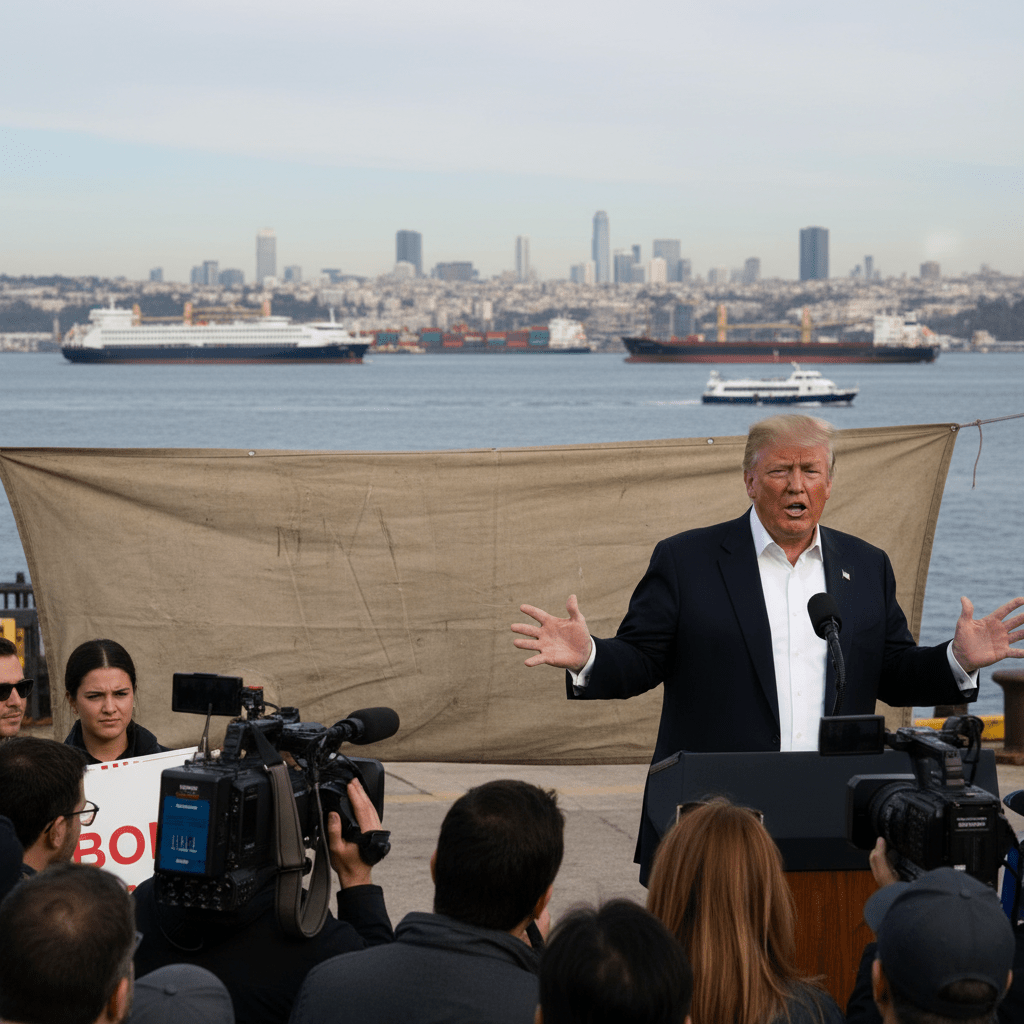
Reports from a recent rally indicate Donald Trump has asserted that the Strait of Hormuz will become “permanently toll-free” as part of an undisclosed agreement with Iran. This claim, made on June 10, 2026, has immediately ignited a complex geopolitical discussion, drawing both fervent support from his base and significant skepticism from international observers and policy experts. The Strait of Hormuz, a critical chokepoint for global oil shipments, has been a flashpoint for decades, making any such agreement a matter of profound economic and security consequence. Understanding the full ramifications requires a detailed examination of the claim, the alleged agreement’s viability, and the reactions across the global stage to this bold pronouncement.
Key Takeaways
- Donald Trump’s claim of a ‘permanently toll-free’ Strait of Hormuz under a new Iran agreement has sparked global debate.
- The alleged agreement’s details remain undisclosed, fueling skepticism from international bodies and regional powers.
- Such a deal would significantly alter global oil markets and shipping dynamics, impacting prices and trade routes.
- Security implications are profound, potentially reshaping naval presence and regional stability in the Persian Gulf.
- The claim carries substantial weight in US domestic politics, particularly for future electoral considerations.
- Verification challenges are considerable, given Iran’s historical stances and the lack of independent confirmation.
The Claim and its Geopolitical Backdrop
Donald Trump’s assertion about the Strait of Hormuz emerged during a campaign event, where he outlined a vision of global trade unburdened by geopolitical friction. His speech centered on achieving seemingly impossible diplomatic feats, often through direct, bilateral negotiations that bypass established multilateral frameworks. The Strait of Hormuz, linking the Persian Gulf with the Arabian Sea, is strategically vital, with approximately one-fifth of the world’s total petroleum consumption passing through its narrow waters daily. For years, the waterway has been subject to various forms of friction, including threats of closure, maritime incidents, and the constant presence of naval forces, contributing to instability and increased shipping costs.
The specific mention of a “permanently toll-free” status introduces a new dimension to this long-standing issue. Historically, no formal tolls are levied for transit through international straits, as enshrined in international maritime law, particularly the United Nations Convention on the Law of the Sea (UNCLOS). However, the region has seen informal costs, such as increased insurance premiums due to perceived security risks, and direct threats or seizures impacting free navigation. Trump’s claim, therefore, might refer to eliminating these broader, de facto financial burdens and security concerns rather than a literal transactional toll, addressing the significant economic pressure points in global energy markets.
This declaration also sits within a broader narrative of US policy towards Iran, which has historically oscillated between engagement and stringent sanctions. The Trump administration previously withdrew from the Joint Comprehensive Plan of Action (JCPOA), reimposing a “maximum pressure” campaign designed to curb Iran’s nuclear program and regional influence. A new agreement, as suggested by Trump, would represent a significant pivot, potentially signaling a return to direct negotiations or a different form of diplomatic engagement. Such a shift would inevitably draw scrutiny regarding its scope, concessions, and alignment with the long-term strategic interests of the United States and its regional allies.
The timing of the announcement, occurring in mid-2026, further amplifies its political and strategic importance. Global energy markets are under constant pressure from various factors, including ongoing supply chain disruptions, shifts in demand patterns, and the persistent conflict in Eastern Europe. Any development that promises to stabilize a major oil chokepoint could be viewed as a significant positive, albeit one that requires careful verification. The claim’s immediate effect has been to inject considerable uncertainty into a volatile region, prompting urgent questions about the specifics of any potential deal and its enforceability in a complex geopolitical landscape.
Scrutiny of the Alleged Agreement’s Details
Crucially, details regarding the purported agreement remain largely undisclosed, prompting immediate skepticism from seasoned diplomats and policy analysts. Trump’s announcement lacked specific information about when such negotiations occurred, who represented the United States and Iran, and the precise terms agreed upon. This lack of transparency is characteristic of certain high-stakes diplomatic maneuvers, but in this instance, it also raises concerns about the feasibility and legitimacy of the claims. Without tangible evidence or official confirmation from either the US State Department or Iranian authorities, the international community is left to speculate on the nature of this unprecedented claim.
The concept of a “permanently toll-free” Strait of Hormuz requires a robust framework for enforcement and dispute resolution. Given the historical mistrust and ongoing tensions between the United States and Iran, any agreement would necessitate substantial guarantees from both sides. Past attempts at de-escalation have often faltered due to a lack of mutual confidence and the complexities of regional proxy conflicts. For such a deal to be genuinely permanent and effective, it would likely require multilateral backing, possibly involving the United Nations or other major powers, to ensure compliance and deter potential violations by either party or other regional actors.
Questions also arise about the potential concessions made by the United States or Iran to secure such an agreement. Iran has consistently leveraged its strategic position over the Strait of Hormuz as a point of influence and negotiation. It is improbable that Iran would agree to relinquish its perceived leverage without substantial benefits in return, which could include sanctions relief, security assurances, or other forms of diplomatic recognition. The absence of these details fuels speculation that the claim might be premature, aspirational, or perhaps entirely unsubstantiated, serving more as a political statement than a verifiable diplomatic achievement.
Moreover, the legal implications of such a claim are complex. While international law generally dictates free passage through international straits, Iran has previously asserted its right to control passage through its territorial waters, which include parts of the Strait. An agreement to ensure a “permanently toll-free” status would require a clear and unambiguous commitment from Iran to uphold these international norms, potentially modifying its historical interpretations of maritime law in the region. Legal experts are already debating how such a commitment would be codified and integrated into international legal frameworks, particularly if it diverges from existing interpretations or if it lacks broader international consensus.
International Repercussions and Skepticism
The international community’s response to Trump’s announcement has been characterized by a mixture of caution and outright skepticism. European allies, who have historically advocated for a return to diplomacy with Iran, have expressed a desire for more concrete details, highlighting the need for any agreement to be robust, verifiable, and consistent with international law. Many European leaders remember the abrupt withdrawal from the JCPOA, which led to increased instability, and are wary of any new, unilateral US initiatives that lack multilateral support. Their cautious approach underscores a fundamental concern about the durability of any bilateral deal between Washington and Tehran without broader international buy-in.
Regional powers, particularly Saudi Arabia and other Gulf Cooperation Council (GCC) states, have reacted with deep apprehension. These nations have long viewed Iran as a primary security threat and have invested heavily in diversifying their shipping routes to reduce reliance on the Strait of Hormuz. Any agreement that seemingly legitimizes Iran’s position or offers it significant concessions without addressing broader regional security concerns would likely be met with strong opposition. Their skepticism is rooted in decades of geopolitical rivalry and a profound distrust of Iranian intentions, suggesting that such a deal could inadvertently exacerbate existing tensions rather than alleviate them.
China and India, major consumers of oil transiting the Strait, would undoubtedly welcome any measure that ensures stability and reduces shipping costs. However, even these nations, typically pragmatic in their foreign policy, would likely seek assurances about the agreement’s long-term viability and enforcement mechanisms. Their primary concern is the uninterrupted flow of energy resources, and any perceived fragility in a US-Iran deal would prompt them to maintain existing alternative supply strategies. The broader Asian market is keenly observing developments, understanding the direct impact on their energy security and overall economic stability, but also awaiting verifiable facts.
The United Nations and other international maritime organizations have refrained from immediate comment, likely awaiting formal communication and detailed proposals from the involved parties. Any change to the established maritime status quo in such a critical international waterway would typically undergo extensive review and require broad international consensus. Without this, any unilateral declaration, even from a major power, risks being perceived as an attempt to bypass international norms rather than reinforce them. The global shipping industry, already grappling with various challenges, is particularly attentive to signals of stability or renewed uncertainty, which directly affect operational costs and insurance premiums.
Economic and Security Implications
The economic ramifications of a truly “permanently toll-free” Strait of Hormuz would be substantial. Reduced security risks and lower insurance premiums for tankers would translate into decreased shipping costs, which could, in turn, lead to a marginal but noticeable dip in global oil prices. This would provide a welcome relief for economies reliant on imported energy, potentially stimulating growth and easing inflationary pressures in certain sectors. Major oil exporters in the Gulf, while potentially facing slightly lower prices, would benefit from increased predictability and reduced logistical hurdles, ensuring more stable revenue streams and potentially higher throughput for their exports.
The impact on global trade routes would also be significant. While some nations have invested in pipelines and alternative shipping routes to bypass the Strait, these often come with their own costs and limitations. A reliably open and secure Strait would reinforce its position as the primary artery for energy transport, potentially making alternative routes less economically attractive. This could centralize more maritime traffic through the Strait, requiring enhanced navigational safety measures and environmental protections to manage the increased volume responsibly. The stability offered would make long-term investment planning in the energy sector more predictable for all stakeholders.
From a security perspective, an agreement ensuring a toll-free Strait implies a significant de-escalation of military tensions in the Persian Gulf. This could lead to a reduction in naval patrols and a re-evaluation of military postures by various international forces, including those of the United States and its allies. Such a shift would be a complex undertaking, requiring careful coordination to avoid creating security vacuums or inadvertently empowering other actors. The long-term stability of the region hinges not just on specific agreements but on a broader framework of trust and mutual respect among all littoral states, which remains a formidable challenge.
However, the reduction in military presence, while potentially lowering operational costs, could also introduce new vulnerabilities if not managed meticulously. The absence of a deterrent force could embolden non-state actors or create opportunities for opportunistic aggression from other regional players. Therefore, any security architecture built upon a “toll-free” agreement would likely require robust monitoring mechanisms, intelligence sharing, and rapid response capabilities to maintain peace. The balance between de-escalation and maintaining credible deterrence would be a delicate act, demanding sustained diplomatic effort and ongoing security cooperation among regional and international partners, which currently appears aspirational.
Political and Implementation Challenges
Domestically, Donald Trump’s claim serves multiple political objectives. For his supporters, it reinforces his image as a decisive dealmaker capable of achieving results where others have failed, particularly concerning long-standing foreign policy challenges. This narrative resonates with a voter base eager for bold action and a departure from conventional diplomacy. Such a pronouncement, even without immediate verification, can mobilize political support and set the agenda for upcoming electoral cycles. It positions him as a strong leader able to bend geopolitical realities to the nation’s advantage, regardless of the complexities involved in actual implementation.
Conversely, political opponents and critics view the claim with deep suspicion, framing it as either an unsubstantiated boast or a dangerous oversimplification of complex international relations. They argue that such a significant agreement would necessarily involve intricate details and concessions that could undermine US interests or alienate allies. The lack of transparency fuels accusations of political opportunism, particularly as the alleged deal remains unconfirmed by any official channels. The political debate in Washington is likely to intensify, with demands for full disclosure and rigorous scrutiny of any proposed framework. The long-term political capital gained or lost will depend heavily on the veracity and viability of this claim.
The practical implementation of a “permanently toll-free” Strait of Hormuz presents considerable challenges. It would necessitate not only Iran’s unwavering commitment but also the cooperation and acceptance of all major maritime nations and regional actors. Establishing trust and a shared understanding of international maritime law in this contested area is paramount. A mechanism for independent verification of compliance, potentially involving international observers, would be essential to ensure transparency and accountability. Without such robust mechanisms, the agreement risks being undermined by minor incidents or competing interpretations of its terms, leading to renewed instability and friction.
Furthermore, the broader context of US-Iran relations, including the status of Iran’s nuclear program, its ballistic missile development, and its regional proxy activities, cannot be ignored. A singular agreement on maritime passage, no matter how significant, would likely be insufficient to address the full spectrum of security concerns. Any truly lasting peace and stability in the Strait would require a more comprehensive diplomatic framework that tackles these interconnected issues. The challenge for any administration would be to integrate this specific claim into a coherent and sustainable foreign policy strategy, rather than treating it as an isolated triumph, demanding a nuanced and long-term approach to a deeply entrenched geopolitical rivalry.
“The claim of a ‘permanently toll-free’ Strait of Hormuz, while aspirational, is fraught with immense complexities. Decades of entrenched distrust and strategic maneuvering between Washington and Tehran mean that such an agreement, if it exists, would demand unprecedented concessions and ironclad verification mechanisms that are currently unfathomable to the broader international community. It represents a significant diplomatic shift that requires far more than a public announcement to be deemed credible or actionable.”
— Dr. Sarah Khan, Senior Geopolitical Analyst, Middle East Institute
| Feature/Aspect | Trump’s Claimed ‘Toll-Free’ Strait Deal | Current/Historical Status of Strait of Hormuz |
|---|---|---|
| Economic Impact on Shipping | Significantly reduced costs, lower insurance premiums, stable oil prices due to predictability. | High insurance premiums due to security risks, fluctuating oil prices influenced by geopolitical tension. |
| Geopolitical Implications | De-escalation of tensions, potential reduction in naval presence, enhanced regional stability. | Constant risk of maritime incidents, military standoffs, persistent regional proxy conflicts, high alert. |
| International Law Adherence | Explicit agreement to uphold free navigation, potentially modifying Iran’s historical interpretation of maritime transit. | International law mandates free passage, but Iran has historically asserted conditional rights based on its territorial waters. |
| Verification & Enforcement | Requires robust, transparent, and possibly multilateral monitoring mechanisms to ensure compliance and deter violations. | Informal enforcement by international naval forces (e.g., US Navy) and unilateral actions by littoral states (e.g., Iran’s seizures). |
| US-Iran Relations Context | Implies a major diplomatic breakthrough or shift from ‘maximum pressure’ to direct engagement, potentially with concessions. | Characterized by stringent sanctions, deep mistrust, sporadic diplomatic efforts, and ongoing adversarial postures. |
| Impact on Global Energy Security | Increased predictability and reliability of oil supply, reduced vulnerability of the critical chokepoint. | Vulnerable to disruptions, supply chain shocks, and unpredictable events that threaten global energy flows. |
| Required Concessions | Likely requires significant reciprocal benefits for Iran (e.g., sanctions relief, security assurances) that remain undisclosed. | No formal concessions beyond respecting international maritime law, but constant pressure from sanctions and military presence. |
Frequently Asked Questions
What is the Strait of Hormuz and why is it so critical for global trade?
The Strait of Hormuz is a narrow, strategic waterway connecting the Persian Gulf to the Arabian Sea and the open ocean. Its critical importance stems from the fact that approximately 20% of the world’s total petroleum consumption, including crude oil and liquefied natural gas, passes through it daily. This makes it an indispensable chokepoint for global energy markets. Any disruption in the Strait, whether due to political tensions, military incidents, or intentional blockades, can have immediate and severe repercussions on international oil prices, shipping costs, and the overall stability of the global economy. Its geopolitical significance is unmatched, as many major oil-producing nations in the Middle East rely on it for their exports, highlighting why any agreement affecting its status is met with such intense scrutiny and global attention, impacting consumers and industries worldwide.
Does international law currently mandate a ‘toll-free’ passage through the Strait of Hormuz?
Yes, under the United Nations Convention on the Law of the Sea (UNCLOS), the Strait of Hormuz, as an international strait, is subject to the right of transit passage, which allows for continuous and expeditious navigation and overflight solely for the purpose of continuous and expeditious transit between one part of the high seas or an exclusive economic zone and another part of the high seas or an exclusive economic zone. This principle explicitly prohibits coastal states from levying tolls or impeding innocent passage. While Iran has not fully ratified UNCLOS, it generally adheres to its provisions regarding transit passage. The ‘toll-free’ aspect in Trump’s claim likely refers to eliminating informal costs, such as prohibitive insurance premiums due to perceived security risks or the implicit ‘costs’ associated with potential harassment and seizure, which have historically burdened maritime traffic in the region despite international legal protections.
What are the primary reasons for skepticism surrounding Trump’s claim of a new agreement with Iran?
Skepticism surrounding Donald Trump’s claim stems primarily from the complete lack of verifiable details and official confirmation from either the US State Department or Iranian authorities. Given the deeply adversarial history between the two nations, particularly under previous administrations including Trump’s, an agreement of such magnitude would typically involve extensive public diplomacy and transparent negotiation. The absence of specific terms, timelines, or named negotiators raises questions about the claim’s basis. Furthermore, Iran’s consistent stance on its sovereign rights over parts of the Strait, coupled with ongoing tensions regarding its nuclear program and regional influence, makes any sudden, comprehensive agreement without significant reciprocal concessions highly improbable in the eyes of many international observers and diplomatic experts. This opaqueness contributes to the widespread distrust and calls for greater transparency.
How might a ‘permanently toll-free’ Strait of Hormuz impact global oil prices and shipping insurance?
A genuinely ‘permanently toll-free’ Strait of Hormuz would likely have a stabilizing, and potentially slightly lowering, effect on global oil prices. Reduced geopolitical risk in such a critical chokepoint would alleviate supply concerns, fostering greater market confidence. The most direct impact would be on shipping insurance premiums, which currently include a substantial ‘war risk’ component due to the Strait’s volatile history. With a verified, lasting agreement, these premiums would drop significantly, directly reducing operational costs for oil tankers and other commercial vessels. This cost saving, passed through the supply chain, could contribute to lower overall transportation expenses, thereby influencing energy commodity prices. Such a development would be welcomed by global economies, offering more predictable and cost-efficient access to vital energy resources.
What would be the challenges in verifying and enforcing such an agreement, given US-Iran relations?
Verifying and enforcing an agreement regarding the Strait of Hormuz between the US and Iran would be a formidable challenge, primarily due to decades of entrenched mistrust. Key obstacles include establishing clear, mutually acceptable definitions of ‘toll-free’ status and compliance benchmarks, which extend beyond literal fees to encompass freedom from harassment or seizure. Robust, independent monitoring mechanisms, potentially involving international bodies or neutral third parties, would be essential to ensure transparency and accountability. Both sides would need to commit to clear dispute resolution processes to prevent minor incidents from escalating. Without comprehensive provisions addressing broader issues like Iran’s nuclear activities or regional proxies, any maritime agreement could be held hostage to other geopolitical frictions, making sustained enforcement difficult and precarious, demanding sustained, high-level diplomatic engagement and a significant shift in the bilateral relationship.