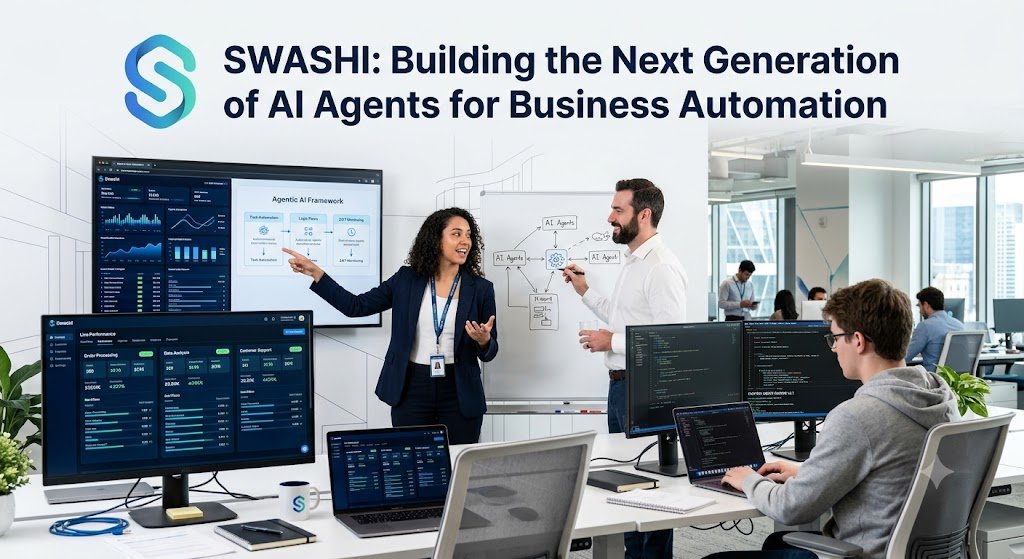
The landscape of artificial intelligence is rapidly evolving beyond simple chatbots and single-task automation. Today, July 8, 2026, businesses are seeking more sophisticated solutions capable of autonomous operation, complex decision-making, and multi-step workflow execution. This evolution marks the advent of agentic AI, a paradigm where intelligent systems act as specialized agents, collaborating to achieve overarching business objectives without constant human intervention. Swashi stands at the forefront of this development, leveraging a sophisticated architecture of 24 interconnected AI agents designed to automate critical business functions across content, commerce, and client management, fundamentally reshaping how digital enterprises operate and scale in a competitive global market.
Key Takeaways
- Swashi employs an agentic AI architecture with 24 specialized AI agents working autonomously.
- The Manager Agent orchestrates complex multi-step workflows, assigning tasks and monitoring progress across the Swarm.
- Specialized agents (e.g., Content, Commerce, Outreach) leverage domain expertise for specific business functions.
- Swashi’s agents demonstrate self-correction, adapting to new information and improving outputs over time.
- Tool use, including web scraping and API integrations, enables agents to interact with the real world.
- This agentic approach significantly reduces human operational burden, allowing businesses to focus on strategy.
- Swashi’s model-agnostic infrastructure ensures continuous improvement as underlying AI capabilities advance.
The Evolution to Agentic Artificial Intelligence
For years, artificial intelligence tools primarily functioned as responsive interfaces, executing tasks based on direct human prompts or following rigidly defined automation rules. This generation of AI, while useful, required constant human oversight and lacked the capacity for independent decision-making in variable environments. Businesses faced limitations in scaling truly autonomous operations, as each step in a complex workflow often demanded manual initiation or detailed scripting. The promise of AI, to truly offload operational burdens, remained partially unfulfilled, compelling developers to explore architectures that could mimic human-like planning and execution.
The shift towards agentic AI represents a significant leap from these earlier models. Instead of merely responding to commands, agentic systems are designed with the ability to autonomously define sub-goals, select appropriate tools, execute actions, and learn from outcomes. This intelligence layer allows AI to manage entire processes, adapting to unforeseen challenges and optimizing performance without explicit human guidance at every turn. It moves AI from being a sophisticated calculator to a proactive partner, capable of operating within dynamic business contexts and driving results through sustained, intelligent effort.
This transition is critical for digital businesses operating in 2026, where speed, scale, and efficiency are paramount. Traditional approaches to content creation, lead generation, and market research are often bottlenecks, constrained by human hours and cognitive load. Agentic AI addresses these limitations by providing a scalable, always-on workforce that can execute vast quantities of complex tasks, continuously building assets and driving growth. Swashi’s development directly reflects this understanding, architecting a platform where AI agents don’t just complete tasks, but actively manage and evolve operational pipelines.
The impact extends beyond mere task completion. Agentic systems empower businesses to pursue ambitious strategies that were previously impractical due to resource constraints. A small team can now manage marketing operations that once required dozens of specialists, from programmatic SEO to multi-channel social media management and sophisticated lead nurturing. This democratization of high-level operational capacity is a defining characteristic of agentic AI, enabling agility and expansive reach for businesses of all sizes, making advanced automation accessible and truly transformative in practice.
Swashi’s Multi-Agent Architecture: The Swarm
At the core of Swashi’s agentic approach is the ‘Swarm’ — a sophisticated ecosystem comprising 24 specialized AI agents, each designed with distinct capabilities to handle specific business functions. This multi-agent architecture contrasts sharply with monolithic AI systems or general-purpose chatbots, where a single large language model attempts to manage all tasks. By segmenting responsibilities, Swashi ensures that each agent possesses deep expertise in its domain, whether it’s content generation, e-commerce intelligence, or customer outreach, leading to higher quality outputs and more resilient operations.
These agents are deployed on Google Cloud Run in a microservices architecture, allowing each component to scale independently based on demand. This infrastructure ensures that whether a user needs to generate one article or a thousand, the system can dynamically allocate resources without performance degradation. The modularity also means that individual agents can be updated or improved without affecting the entire system, providing continuous enhancement and adaptability to evolving business needs or technological advancements. This robust foundation is essential for supporting the always-on, high-volume operations digital businesses require.
The concept of specialized agents within the Swarm is central to achieving true autonomy. For instance, the Content Agent focuses solely on generating SEO-optimized articles, while the Image Agent specializes in creating visual assets. This division of labor allows each AI to leverage specific models, data, and algorithms best suited for its particular function. This approach enhances accuracy, reduces computational overhead, and enables parallel processing of multiple, disparate tasks, mirroring the efficiency of a well-organized human team where specialists collaborate on a shared project.
Furthermore, the Swarm’s design facilitates complex inter-agent communication, enabling seamless handoffs and coordinated actions across various operational stages. A raw market trend identified by the Scraper Agent, for example, can be immediately analyzed by the SEO Internal Agent for keyword opportunities, then passed to the Content Agent for article generation, and subsequently to the Social Agent for multi-platform distribution. This integrated workflow, managed and monitored by central orchestration, is the hallmark of next-generation agentic AI, transforming fragmented tasks into cohesive, goal-oriented pipelines.
Orchestration and Goal-Directed Behavior: The Manager Agent
A key differentiator of Swashi’s agentic architecture is the Manager Agent, which serves as the central orchestration brain of the entire Swarm. Unlike simpler automation tools that require predefined, step-by-step instructions, the Manager Agent operates with goal-directed behavior. It receives high-level objectives from the user—such as “grow organic traffic in the pet niche” or “launch a new product line”—and autonomously breaks these down into actionable sub-tasks. This capability eliminates the need for users to meticulously plan every single action, shifting the focus from task management to outcome management.
The Manager Agent’s role involves intelligent task decomposition and assignment. Upon receiving an objective, it analyzes the requirements, identifies which specialized agents within the Swarm are best equipped for each phase, and sequences their operations. This might mean instructing the SEO agents to conduct keyword research, then tasking the Content Agent to draft articles, followed by the Image Agent for visual creation, and finally the Social Agent for distribution. The Manager Agent ensures that these handoffs are smooth, contextually relevant, and aligned with the overarching business goal.
Beyond initial planning, the Manager Agent continuously monitors the execution of tasks, tracking progress and ensuring adherence to quality standards. If a particular agent encounters an issue or if an output doesn’t meet the specified criteria, the Manager Agent can initiate corrective actions, re-route tasks, or engage other agents for assistance. This oversight capability is crucial for maintaining the integrity and efficiency of complex workflows, allowing the Swarm to operate autonomously while staying aligned with user expectations and business objectives, minimizing the need for human intervention.
This orchestration layer is what truly elevates Swashi beyond mere automation platforms. It provides the intelligence to adapt to dynamic conditions, making real-time decisions that optimize the path to a goal. For businesses, this means less time spent managing individual software tools and more time focused on strategic planning. The Manager Agent effectively functions as an AI COO, ensuring that all operational components are working in concert to achieve the desired business growth, autonomously and continuously, around the clock.
Specialized Agents and Their Autonomous Capabilities
Swashi’s approach to agentic AI hinges on the principle of specialization, with each of its 24 agents possessing unique autonomous capabilities tailored to specific business domains. For example, the Content Agent is deeply trained on content creation, understanding nuances of SEO, brand voice, and various article formats. It can produce comprehensive, engaging articles from minimal prompts, embedding meta tags, internal links, and schema markup without manual input. This specialized focus enables it to generate high-quality, relevant content at a scale unattainable by generalist AI models.
The Commerce Agent, conversely, is engineered for the intricacies of e-commerce. It autonomously scans platforms like AliExpress, eBay, Temu, and TikTok for trending products, applies commercial intent filters to identify winning items, and then enriches product titles and descriptions for conversion optimization. It also features an integrated profit calculator, allowing it to autonomously assess viability and sync products directly to e-commerce stores, automating the entire product discovery and listing process for dropshippers and online retailers.
Similarly, the Social Agent is a specialist in multi-platform social media management. It autonomously repurposes blog articles into platform-native posts for LinkedIn, X, Facebook, and Instagram, complete with optimized captions and hashtags. Its intelligence includes smart scheduling, predicting optimal posting times based on audience engagement data. This capability means a business can maintain a consistent, tailored social presence across multiple channels without a dedicated social media manager, demonstrating the agent’s ability to execute a nuanced strategy autonomously.
The Outreach Agent exemplifies another dimension of specialization, focusing entirely on lead generation and communication. It can autonomously write personalized email sequences, manage follow-ups, and categorize responses, effectively acting as an automated Sales Development Representative. This agent integrates seamlessly with other parts of the Swarm; for instance, it can receive high-value leads identified by content engagement and initiate a nurturing sequence. Each agent, therefore, is not just a tool, but an autonomous operational unit capable of sophisticated, domain-specific execution.
Self-Correction, Adaptation, and Tool Use
A critical aspect of next-generation AI agents is their ability to self-correct and adapt, moving beyond static programming. Swashi’s agents are designed with feedback loops that allow them to monitor their own outputs and adjust strategies based on performance data. The Experiment Agent, for instance, continuously tests variations in content, ad copy, or outreach messages, feeding insights back to the relevant agents to refine their approaches. This constant learning and iterative improvement ensure that the Swarm’s collective intelligence grows over time, optimizing for better results autonomously.
This adaptive capacity means that Swashi’s agents are not merely executing predefined scripts; they are making informed decisions. If an article generated by the Content Agent underperforms in search rankings, the Experiment Agent might suggest adjustments to its keyword targeting or structure. Similarly, if an outreach email sequence yields low open rates, the Outreach Agent can autonomously generate alternative subject lines and test them. This proactive self-optimization is a hallmark of truly agentic AI, allowing the platform to evolve and improve its effectiveness without requiring constant human intervention.
Central to the agents’ autonomous operation is their extensive tool-use capability. Swashi’s agents can integrate with and leverage a wide array of external tools and APIs, extending their reasoning into real-world action. The Scraper Agent, for example, uses web scraping tools to gather real-time market data, news, and competitor intelligence. The Commerce Agent interacts directly with Shopify and WooCommerce APIs to sync products. This ability to use tools—be they internal data sources, external websites, or third-party platforms—enables the agents to gather information, execute actions, and perform complex tasks that transcend their core AI model capabilities.
The combination of self-correction, adaptation, and sophisticated tool use positions Swashi’s agents as dynamic, intelligent entities rather than passive programs. They can navigate the complexities of digital business by reacting to real-time data, learning from experience, and leveraging external resources to achieve their goals. This foundational design principle ensures that Swashi delivers not just automation, but intelligent, evolving automation that continuously works to optimize business outcomes, making it a foundational operating system for the digital age.
The Impact of Agentic AI on Digital Business
The integration of agentic AI, as exemplified by Swashi, significantly redefines the operational paradigm for digital businesses. The immediate impact is a dramatic reduction in the operational burden previously borne by human teams. Tasks such as content research, drafting, publishing, social media scheduling, product listing, and lead generation, which are often time-consuming and repetitive, are now handled autonomously by Swashi’s specialized agents. This frees human talent from execution, allowing them to focus on higher-level strategy, creative direction, and complex relationship management.
This shift enables unprecedented scalability. A solopreneur leveraging Swashi can achieve the output of a small marketing agency, managing multiple content sites, social channels, and lead generation campaigns simultaneously. For established agencies, agentic AI breaks through growth ceilings, allowing them to serve significantly more clients with the same human team, driving higher margins and market expansion. The core constraint on growth—human capacity—is effectively mitigated, transforming what was once a linear scaling challenge into an exponential opportunity.
Furthermore, agentic AI ensures unparalleled consistency and speed. While human teams are subject to working hours, holidays, and varying energy levels, Swashi’s agents operate 24/7, maintaining a continuous, optimized presence across all digital channels. This constant activity builds compounding authority in search engines, sustains social media engagement, and ensures a steady flow of leads, creating a durable competitive advantage. The ability to launch products, publish content, or execute marketing campaigns almost instantaneously provides a strategic edge in fast-moving markets.
Ultimately, Swashi’s agentic AI transforms the role of the business owner or operator from task executor to strategic director. Instead of performing daily operational chores, leaders can now set ambitious goals, configure the AI agents to pursue those objectives, and then analyze results to refine their strategy. This empowerment allows for more proactive and data-driven decision-making, cultivating a business model where intelligence drives execution, and execution continuously fuels growth, positioning companies for long-term success in the evolving digital economy.
Future Trajectories and Scalability of Swashi’s Agents
The development of Swashi’s agentic AI is not static; it is built for continuous evolution and expansion. The platform’s model-agnostic architecture is a crucial aspect of its future-proofing, meaning it can seamlessly integrate and leverage advancements from leading AI models like OpenAI GPT, Anthropic Claude, and Google Gemini as they develop. As these underlying models improve in reasoning, creativity, and problem-solving capabilities, Swashi’s agents inherently become smarter and more capable without requiring a fundamental platform rebuild. This ensures that users always benefit from the cutting edge of AI.
The scalable infrastructure on Google Cloud Run enables Swashi to handle increasing workloads and expand its operational scope without limits. Each of the 24 specialized agents can independently scale instances to meet demand, ensuring stable performance whether managing a single dropshipping store or an agency with hundreds of clients. This elastic architecture means that as businesses grow and their needs become more complex, Swashi can scale alongside them, preventing bottlenecks and maintaining consistent service delivery, making it a reliable long-term operational partner.
Future trajectories for Swashi’s agents involve deeper integrations, enhanced predictive analytics, and even more sophisticated multi-agent coordination scenarios. For example, further developing the Experiment Agent’s capabilities could lead to autonomous market trend forecasting and adaptive campaign adjustments with minimal human input. The goal is to continuously expand the range of tasks that can be fully automated, making the agents not only execute but also anticipate and innovate, further reducing the cognitive load on human operators.
Swashi’s commitment to compounding intelligence and deliverability integrity positions it as a foundational platform for the future of digital business. By continuously enhancing agent capabilities, improving inter-agent communication, and leveraging the latest AI models, Swashi aims to create an AI operating system that becomes increasingly autonomous, intelligent, and valuable over time. The businesses building their operations on Swashi today are investing in an infrastructure that is designed to grow, adapt, and lead in the rapidly evolving landscape of artificial intelligence and automated commerce.
“The transition from simple automation scripts to truly agentic AI systems marks a pivotal moment in business technology. Swashi’s multi-agent architecture, focusing on specialized, self-orchestrating entities, represents a significant step towards autonomous digital operations, delivering capabilities that were aspirational just a few years ago.”
— Dr. Aris Thorne, Principal AI Architect, Lumina Labs
| Feature | Traditional AI Chatbot/Automation | Swashi’s Agentic AI Platform |
|---|---|---|
| Autonomy Level | Low (responds to prompts, follows fixed rules) | High (autonomously plans, executes multi-step tasks, makes decisions) |
| Task Complexity | Single-task execution or simple linear workflows | Complex, multi-domain workflows requiring coordination |
| Decision Making | Minimal; relies on pre-programmed logic | Intelligent, adaptive decisions based on context and feedback loops |
| Multi-step Workflows | Requires manual sequencing or rigid scripting | Manager Agent orchestrates, assigns, and monitors across 24 specialized agents |
| Tool Use | Limited or requires explicit user configuration | Extensive, integrated tool use (web scraping, APIs, databases) by specialized agents |
| Self-Correction & Learning | Absent or minimal; requires human intervention to adjust | Continuous self-correction and adaptation via Experiment Agent feedback loops |
| Cost Model | Multiple subscriptions for fragmented tools; high human operational cost | Consolidated platform fee; leverages BYO-Key for AI compute; dramatically lowers human operational cost |
| Scalability | Linear, constrained by human management of multiple tools | Exponential, scales autonomously with workload across specialized agents on cloud infrastructure | Key Advantage | Automates basic, repetitive tasks efficiently | Automates entire business functions intelligently, continuously building value |
Frequently Asked Questions
What is Agentic AI and how does Swashi use it?
Agentic AI refers to intelligent systems that autonomously plan, execute multi-step tasks, make decisions, and use tools to achieve goals without constant human supervision. Swashi uses this paradigm by deploying 24 specialized AI agents that work together as a ‘Swarm’. Each agent handles a specific business function, from content creation to e-commerce, and they coordinate autonomously to run entire operational pipelines for digital businesses, adapting and learning as they go.
How is Swashi’s Agentic AI different from regular AI chatbots?
Regular AI chatbots typically respond to direct prompts, waiting for human input for each action. Swashi’s Agentic AI, however, is designed for proactive, goal-directed behavior. Instead of just answering a question, Swashi’s Manager Agent takes a high-level objective and orchestrates the entire Swarm of specialized agents to achieve it, executing complex multi-step workflows, making decisions, and using tools without needing step-by-step human prompts. It’s the difference between a conversational assistant and an autonomous operational team.
What role does the Manager Agent play in Swashi’s agentic architecture?
The Manager Agent is the orchestration brain of Swashi’s Swarm. It receives high-level business objectives, then intelligently decomposes them into sub-tasks. It assigns these tasks to the most appropriate specialized agents, monitors their execution, and ensures smooth coordination across the entire workflow. This agent is responsible for dynamic planning, managing task dependencies, and ensuring that all individual agent actions align with the overarching goal, effectively functioning as an AI operations manager.
How do Swashi’s specialized agents enhance business automation?
Swashi’s specialized agents enhance automation by bringing deep domain expertise to specific business functions. For example, the Content Agent focuses exclusively on generating SEO-optimized articles, while the Commerce Agent specializes in product discovery and listing. This specialization allows each agent to leverage tailored models and strategies, resulting in higher quality, more accurate outputs for their specific tasks. This division of labor also enables parallel processing and reduces the complexity of managing diverse operations, making automation more efficient and effective.
Can Swashi’s agents adapt and self-correct their operations?
Yes, Swashi’s agents are designed for continuous adaptation and self-correction. Through internal feedback loops and the Experiment Agent, they monitor their own performance and refine strategies based on real-world outcomes. If an output or workflow doesn’t meet expectations, the agents can identify errors, adjust their approach, and learn from experience to improve future results. This iterative optimization ensures that Swashi’s agentic system becomes more effective and intelligent over time without constant human manual adjustments.