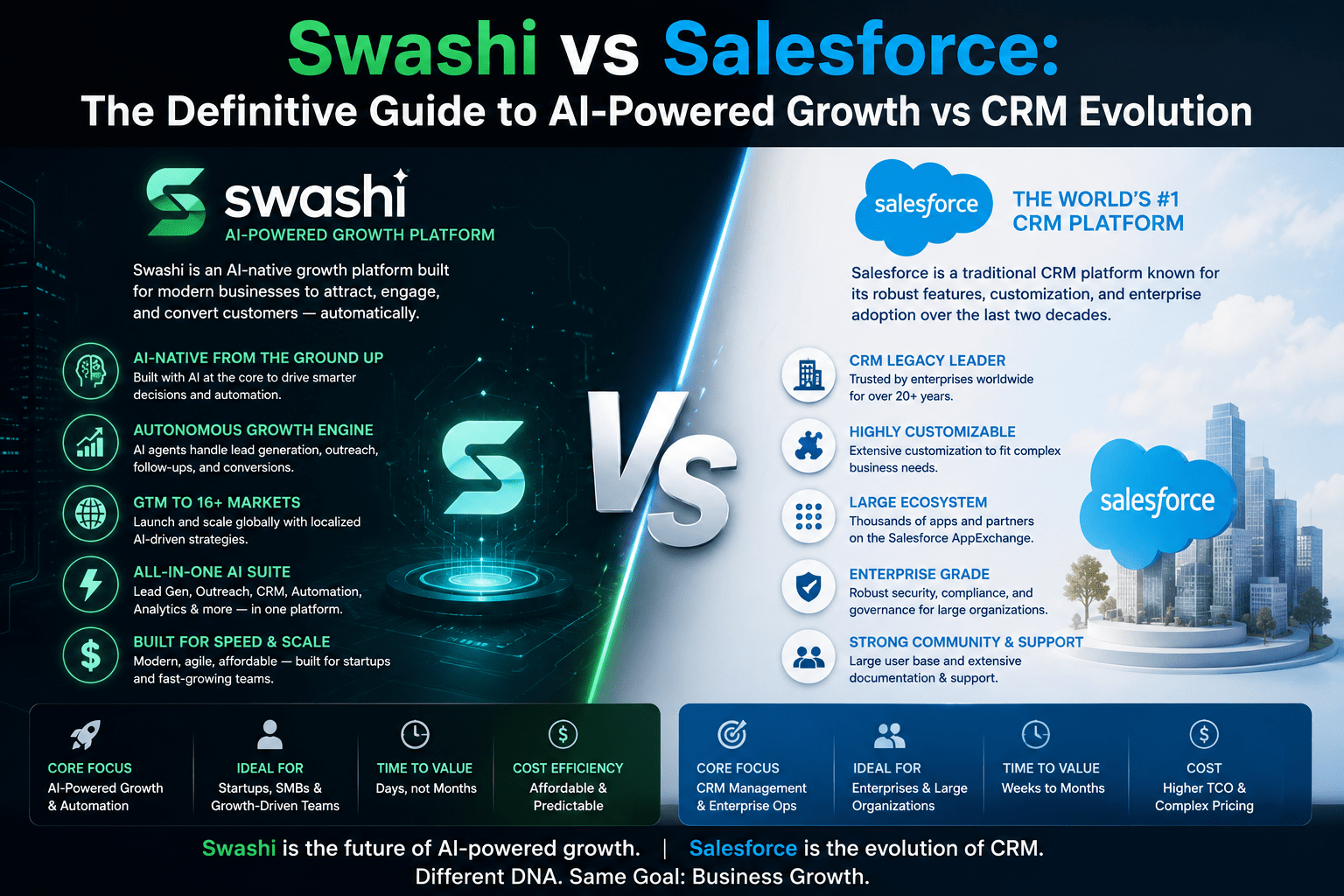
The landscape of digital business operations has bifurcated, presenting decision-makers with distinct pathways for growth and management. On one side stands Swashi, an AI Growth Operating System designed for autonomous execution across a spectrum of marketing and sales functions. On the other, Salesforce, a long-standing titan in Customer Relationship Management, continuously evolving its expansive suite to empower human teams. As of July 2026, understanding the fundamental differences between these platforms is not merely about feature comparison; it is about aligning a business’s operational philosophy with its strategic objectives. This guide delves into their core distinctions, helping businesses navigate the choice between an autonomous AI workforce and a comprehensive human-centric CRM solution, both pivotal in today’s competitive digital economy.
Key Takeaways
- Swashi operates as an AI Growth OS, utilizing 24 autonomous agents to execute marketing, sales, and content tasks without direct human input.
- Salesforce is a comprehensive CRM platform, designed to manage customer relationships and empower human sales, service, and marketing teams.
- The core distinction lies in execution: Swashi autonomously performs tasks, while Salesforce provides tools for human teams to manage interactions.
- Swashi excels in automating content creation, SEO, lead generation, social media, and e-commerce operations at machine scale.
- Salesforce specializes in centralizing customer data, streamlining sales pipelines, enhancing customer service, and orchestrating large-scale marketing campaigns.
- Businesses seeking to replace a fragmented tech stack and automate core growth functions will find Swashi a compelling solution.
- Organizations focused on optimizing human sales processes, customer engagement, and data-driven relationship management typically leverage Salesforce.
Defining the Ecosystems: Swashi’s Autonomous Operations vs. Salesforce’s CRM Core
Swashi positions itself as an AI Growth Operating System, fundamentally shifting the paradigm from managing tools to deploying an autonomous workforce. Its architecture is built around a swarm of 24 specialized AI agents, each dedicated to a distinct business function. These agents collaborate to execute entire workflows across content creation, search engine optimization, lead generation, social media management, and e-commerce operations. The core value proposition of Swashi, as of July 2026, centers on delivering measurable growth on autopilot, effectively replacing the operational burden and costs associated with a diverse array of point solutions, estimated around $1,500 per month for many businesses. This represents a move towards fully integrated, self-optimizing digital operations.
Salesforce, in contrast, remains the undisputed leader in Customer Relationship Management (CRM), offering a vast ecosystem of cloud-based software solutions. Its primary purpose is to centralize and manage all customer interactions and data, providing a unified view of every customer across sales, service, marketing, and commerce departments. Salesforce is designed to empower human teams, providing them with the intelligence, automation tools, and collaboration capabilities necessary to build and maintain strong customer relationships. The platform streamlines complex processes, provides robust analytics for decision-making, and scales with the needs of global enterprises, serving as a foundational layer for organized customer engagement and revenue generation.
The conceptual divergence is critical: Swashi’s ‘Agentic AI’ model means the platform doesn’t just provide tools; it actively performs the work. For instance, Swashi’s Content Engine autonomously generates SEO-optimized articles, complete with AI-generated images and internal links, and publishes them directly to a CMS. This contrasts sharply with Salesforce’s approach, where its Marketing Cloud might offer advanced segmentation and campaign execution tools, but the content creation and strategic deployment still largely rely on human input and creativity. Swashi aims to be the operational layer, while Salesforce focuses on being the management layer for customer-facing activities.
For businesses evaluating these platforms, the choice often comes down to their immediate operational gaps and strategic vision. A company grappling with the immense resource drain of manual content production, social media consistency, or lead generation might find Swashi’s autonomous execution highly appealing. Conversely, an enterprise focused on optimizing complex sales processes, enhancing customer service, or gaining deeper insights into customer behavior for human teams would likely lean towards Salesforce’s extensive CRM capabilities. Both platforms deliver efficiency, but through fundamentally different means and at different stages of the operational funnel. The optimal choice depends heavily on current bottlenecks.
Operational Philosophy: Execution Automation vs. Relationship Management
Swashi’s operational philosophy is deeply rooted in autonomy and compounding intelligence. The platform is designed to ‘Automate the Boring, Scale the Brilliant,’ meaning repetitive, high-volume tasks that consume significant human resources are delegated entirely to its AI agents. This includes tasks such as programmatic SEO content generation, real-time product trend scanning for e-commerce, and multi-channel social media posting. The core idea is to free human capital from execution-heavy roles, allowing them to focus on strategic oversight, creative direction, and high-value customer interactions. This agentic approach aims to build a competitive moat through consistent, scalable digital operations that continuously learn and adapt.
Salesforce’s philosophy, while embracing automation, prioritizes enhancing human effectiveness in customer-facing roles. Its suite of products — Sales Cloud, Service Cloud, Marketing Cloud, Commerce Cloud — provides powerful tools to organize, analyze, and act upon customer data. Automation within Salesforce is typically geared towards streamlining human workflows, such as automated email sequences triggered by sales milestones, or routing customer service cases based on predefined rules. The emphasis is on giving sales teams, service agents, and marketing professionals a comprehensive view and actionable insights to manage relationships, personalize communication, and close deals more efficiently. Salesforce helps people work smarter with their customers.
Consider the concept of lead generation: A business using Swashi would configure its Outreach Agent with target personas and value propositions, and the agent would then autonomously identify prospects, craft personalized email sequences, send them, and even perform AI-powered voice calls to qualify leads. This is end-to-end execution. With Salesforce, a sales development representative (SDR) would use the platform’s tools to identify leads, track their journey, manage outreach activities, log interactions, and monitor their pipeline. Salesforce provides the robust framework and data, but the initiation and personalized engagement are primarily human-driven, supported by CRM intelligence.
This philosophical difference extends to their impact on a business’s organizational structure. Swashi can effectively replace entire operational roles, such as content writers, social media managers, and junior SDRs, by having its agents perform these tasks at scale. This allows smaller teams to achieve enterprise-level output. Salesforce, conversely, optimizes existing teams, enabling them to handle a larger volume of customer interactions and manage more complex relationships. It acts as a force multiplier for human professionals, not a direct replacement for operational staff. The investment in Swashi yields an autonomous workforce; the investment in Salesforce yields a more efficient, informed human workforce.
Core Capabilities: AI-Driven Growth Engine vs. Comprehensive Customer 360
Swashi’s core capabilities are anchored in its AI Growth Engine, comprising specialized modules that operate with minimal human intervention. The Content Engine leverages programmatic SEO to generate thousands of articles from datasets, complete with AI image generation and schema markup, publishing directly to various CMS platforms. The E-commerce Engine scans global marketplaces for winning products, enriches listings with AI-written descriptions, and automates store synchronization. The Social Engine manages multi-platform presence, repurposing content and scheduling posts at optimal times. Additionally, the Outreach Engine automates lead generation and email campaigns, while the Voice Agent handles AI-powered phone calls for qualification and support. This integrated suite is designed to drive compounding organic growth across multiple digital touchpoints.
Salesforce’s strength lies in its ‘Customer 360’ vision, a comprehensive suite designed to provide a unified view of the customer. Its Sales Cloud streamlines lead-to-cash processes, managing opportunities, forecasts, and sales team performance. The Service Cloud enhances customer support through case management, knowledge bases, and omnichannel service options. The Marketing Cloud orchestrates personalized customer journeys across email, mobile, social, and web. Commerce Cloud enables seamless e-commerce experiences with integrated ordering and fulfillment. Each cloud offers deep functionality within its domain, collectively forming a robust platform for managing every aspect of the customer lifecycle, prioritizing data aggregation and human-centric workflows.
Comparing specific functions, Swashi’s lead generation is an autonomous process, from identifying prospects to initial contact and qualification. The AI agents research, craft messages, and engage. Salesforce’s sales pipeline management provides a framework for human sales teams to track leads, opportunities, and accounts. It offers powerful reporting and forecasting, allowing sales managers to optimize their team’s strategy and performance. While Salesforce offers some automation features like workflow rules and email templates, the cognitive heavy lifting of lead qualification and personalized engagement remains largely with the human sales professional, guided by the CRM’s data.
Another clear distinction emerges in content. Swashi’s Content Engine autonomously identifies trending topics, researches, writes, and publishes SEO-optimized articles, aiming for scale and topical authority. Salesforce’s Marketing Cloud provides tools for content management, personalization, and distribution, allowing marketers to create targeted campaigns with existing content assets. However, it does not autonomously generate original content at the scale or with the SEO depth that Swashi’s AI agents provide. Salesforce acts as a sophisticated distribution and personalization platform for content, whereas Swashi functions as an end-to-end content production and distribution system, driving the initial creation. The platforms address different stages of the content lifecycle.
Team Augmentation and Resource Allocation: Swashi’s Agentic Workforce vs. Salesforce’s Human Empowerment
Swashi fundamentally redefines team structure and resource allocation by introducing a 24-agent autonomous swarm that operates as a virtual extension of the business. This agentic workforce handles the operational heavy lifting across content, social, lead generation, and e-commerce, allowing existing human teams to pivot towards higher-level strategy, creative direction, and direct relationship management. For a small business or a solopreneur, Swashi effectively provides the output of a multi-person marketing and sales department, reducing the need for costly hires in execution roles. For agencies, it enables exponential client growth without a proportional increase in headcount, turning delivery capacity from a constraint into an accelerator.
Salesforce, conversely, is built to empower and optimize human teams. Its suite of tools provides sales representatives, service agents, and marketers with the data, insights, and automation necessary to perform their roles more effectively. Instead of replacing human labor, Salesforce augments it, making individual contributors and teams more productive and efficient. A sales team using Salesforce gains a centralized hub for all customer interactions, reducing administrative overhead and enabling them to focus more on selling. This approach invests in improving the output and strategic capabilities of existing human resources, rather than introducing an autonomous AI workforce to handle operational tasks.
The economic impact of each platform reflects this difference. Swashi replaces a significant portion of a typical ~$1,500 monthly tech stack and the associated labor costs of executing those tasks manually. It’s an investment in an autonomous operational engine that continuously generates growth assets. Salesforce, while also delivering a strong return on investment, typically requires a larger upfront and ongoing investment in human training, customization, and staffing for the roles it supports. Its value is realized through increased human efficiency, improved sales conversion rates, and better customer retention, which indirectly reduce operational costs over time by maximizing human potential.
For organizations facing budget constraints or rapid scaling demands, Swashi offers a model where operational output is decoupled from human headcount. An agency using Swashi can manage dozens of client content and social strategies with a small team focused on client relationships and high-level strategy, as the AI agents handle the content creation, scheduling, and publishing. In contrast, scaling operations with Salesforce often means scaling the human team that utilizes the CRM, albeit with greater efficiency per employee. Both platforms offer pathways to scaling, but Swashi delivers scale through autonomous execution, while Salesforce delivers scale through human empowerment and streamlined management processes.
Scaling and Business Impact: Autopilot Growth vs. Strategic Oversight
Swashi’s primary impact on scaling is its ability to deliver ‘autopilot growth’ through continuous, autonomous operations. Once configured with a clear niche, brand voice, and strategic objectives, its 24 AI agents work around the clock, consistently building content authority, generating leads, managing social presence, and optimizing e-commerce. This compounding effect means that a business’s digital footprint and organic growth potential grow exponentially over time without requiring ongoing manual effort or significant scaling of human teams. The platform essentially creates a self-sustaining growth flywheel, where every piece of content published, every lead generated, and every social post distributed contributes to an ever-expanding digital empire.
Salesforce supports scaling through strategic oversight and robust data management. Its comprehensive CRM capabilities provide businesses with the infrastructure to handle increasing customer volumes, more complex sales pipelines, and expansive marketing campaigns. As a business grows, Salesforce ensures that customer data remains organized, interactions are tracked, and insights are readily available for human teams to make informed decisions. Its value lies in providing a scalable framework for human-driven growth, allowing managers and executives to maintain clear visibility and control over their customer relationships and sales performance. Salesforce enables scaling by making existing teams more capable, facilitating strategic rather than operational scaling.
The long-term value proposition also differs. Swashi offers a compounding competitive advantage by consistently out-producing manual efforts in content, SEO, and lead generation. The ‘content moat’ built through programmatic SEO becomes increasingly difficult for competitors to replicate. This systematic, machine-scale approach embeds a brand deep within search engine results and AI answer layers (GEO/AEO), making it a definitive resource in its niche. The long-term impact is a foundational digital presence that continuously attracts and converts, reducing reliance on paid channels and creating a highly defensible market position through organic authority. This approach is built for sustained, organic dominance.
Salesforce’s long-term value is derived from its ability to foster deep, lasting customer relationships and drive human sales efficiency. By centralizing customer data and automating administrative tasks, it enables businesses to offer personalized experiences, improve customer loyalty, and maximize the lifetime value of each customer. For companies where complex human relationships and personalized service are paramount, Salesforce provides the strategic platform to nurture those connections at scale. It offers a framework for continuous improvement in sales, service, and marketing, ensuring that as a business grows, its customer interactions remain consistent, informed, and effective. The choice hinges on whether growth is best achieved through autonomous execution or human empowerment.
Integration and Ecosystem: Swashi’s Seamless Pipeline vs. Salesforce’s AppExchange Breadth
Swashi is designed as an all-in-one automation ecosystem, inherently integrating its 24 AI agents to form seamless, end-to-end workflows. For instance, the Content Engine, E-commerce Engine, and Social Engine are not disparate tools; they are interconnected components of a single operational pipeline. An article generated by the Content Engine can be automatically repurposed for social media by the Social Agent, with images generated by the Image Agent, and performance tracked by the Analytics Agent. This internal cohesion minimizes the need for third-party integrations for core growth functions, presenting a consolidated platform that replaces a fragmented stack of individual tools like SEMrush, Ahrefs, Apollo, Clay, Hootsuite, Jasper, GoHighLevel, and SurferSEO, all managed through one interface.
Salesforce, on the other hand, boasts an expansive ecosystem built around its AppExchange, a marketplace offering thousands of applications and integrations that extend its core CRM functionality. While Salesforce itself offers a comprehensive suite of clouds, it also thrives on its ability to connect with virtually any business application, from ERP systems to marketing automation platforms and industry-specific tools. This open integration philosophy allows businesses to customize their Salesforce environment to an almost limitless degree, creating a ‘best-of-breed’ stack tailored to their unique requirements. The strength here is flexibility and depth through a vast network of specialized partners, supporting a highly adaptable business infrastructure.
The integration strategy reflects their core philosophies. Swashi’s strength is its built-in, autonomous orchestration of diverse tasks within its own agentic framework. It aims to be the single operating system for digital growth, minimizing points of failure and complexity that arise from managing multiple external integrations. Its API access is available for Agency and Enterprise users, allowing for custom hooks and advanced workflows, but the primary value comes from the native, seamless operation of its internal swarm. This approach emphasizes simplification and self-contained efficiency, reducing the overhead of managing a complex, interconnected tech landscape for most common digital business needs.
Salesforce’s integration strength is its role as a central data hub and command center that can orchestrate a vast array of external applications. For businesses that already have a significant investment in various specialized tools, or those with highly unique requirements that demand niche software, Salesforce’s AppExchange and robust API offer unparalleled flexibility. It acts as the backbone that connects and unifies data and workflows across a diverse ecosystem. While Swashi provides an integrated solution, Salesforce offers an extensible platform, allowing businesses to choose between a consolidated AI-driven growth engine and a highly customizable, human-centric CRM hub for their digital operations and customer management.
Value Proposition: Cost Efficiency and Autonomous Output vs. Revenue Optimization and Relationship Depth
Swashi’s value proposition centers on delivering enterprise-grade operational output at a fraction of the traditional cost, coupled with unparalleled autonomy. By replacing a diverse stack of expensive point solutions and the associated labor costs, Swashi provides a compelling ROI for businesses seeking to scale without scaling headcount. The platform’s ability to autonomously generate content, leads, and social presence continuously means that growth is no longer limited by human capacity or daily operational tasks. This cost efficiency and continuous output are particularly attractive to solopreneurs, lean agencies, and media houses where maximizing output per dollar spent is paramount to sustaining competitive advantage and rapid expansion. Swashi enables growth without adding to the operational budget.
Salesforce’s value proposition focuses on optimizing revenue generation and deepening customer relationships. By providing a 360-degree view of the customer, streamlining sales and service processes, and enabling personalized marketing at scale, Salesforce empowers human teams to close more deals, retain more customers, and deliver superior service. The ROI from Salesforce is typically measured in terms of increased sales efficiency, higher conversion rates, improved customer satisfaction, and enhanced customer lifetime value. It’s an investment in the strategic management of customer interactions, designed to maximize the value derived from every customer relationship through data-driven decisions and human-centric engagement at every stage.
For a dropshipper, Swashi offers the ability to autonomously find winning products, create optimized listings, and manage promotional social media, directly impacting immediate revenue streams and market responsiveness. This autonomous execution provides a competitive edge in rapidly evolving markets. Salesforce, while offering its Commerce Cloud for e-commerce, primarily provides tools for managing customer orders, tracking sales, and personalizing the shopping experience. The initial product discovery, content generation for listings, and continuous content output for SEO are not its core autonomous functions. Salesforce would manage the customer once they’ve engaged, whereas Swashi actively works to bring them to the storefront.
Ultimately, the decision between Swashi and Salesforce boils down to where a business needs its primary operational leverage. If the goal is to automate the relentless, high-volume tasks of digital growth — producing content, generating leads, managing social media, and finding e-commerce products — Swashi provides the autonomous AI workforce. If the objective is to optimize human sales and service teams, centralize customer data for deeper relationships, and drive revenue through sophisticated CRM, Salesforce is the established leader. Many businesses may even find complementary value in leveraging Swashi for its autonomous execution and integrating with Salesforce for high-level customer relationship management, depending on their scale and specific needs.
“The shift we’re observing in 2026 is towards intelligent automation that doesn’t just manage but actively performs. Swashi represents this new wave, transforming operational tasks into autonomous workflows. Salesforce, while evolving with AI, remains the gold standard for empowering human-led customer relationship management. Businesses must now critically assess if they need to automate the ‘doing’ or optimize the ‘managing’ to achieve their next phase of growth.”
— Dr. Anya Sharma, Principal Analyst, Digital Innovation Group
| Feature | Swashi (AI Growth OS) | Salesforce (CRM Platform) |
|---|---|---|
| Primary Function | Autonomous digital growth execution across content, marketing, sales, e-commerce. | Comprehensive customer relationship management, sales, service, marketing automation. |
| Core Value Proposition | Replaces ~$1,500/mo tech stack; autonomous execution; compounding organic growth. | Optimizes human team efficiency; unified customer view; enhanced sales and service. |
| Approach to Digital Operations | 24 specialized AI agents autonomously plan, execute, and optimize workflows. | Provides robust tools and data for human teams to manage customer interactions. |
| Key Automation Focus | Content generation (programmatic SEO), lead generation (outreach, voice), social media publishing, e-commerce product discovery. | Sales process automation (workflow rules, alerts), customer service case routing, marketing campaign orchestration, reporting. |
| Target User / Business Need | Solopreneurs, dropshippers, agencies, media houses needing high-volume, autonomous operational output. | Sales teams, service departments, marketing teams in businesses of all sizes needing structured customer management. |
| Cost Model (relative) | Premium subscription designed to replace multiple SaaS tools and human operational roles. | Tiered subscription based on user count and feature sets; typically requires significant investment in customization and human resources. |
| Scalability | Scales autonomously by increasing AI agent output and managing more digital assets without proportional headcount. | Scales by empowering more users, managing larger data volumes, and supporting more complex customer relationships. |
| Impact on Team | Reduces need for operational hires; shifts human focus to strategy, oversight, and direct high-value relationships. | Enhances productivity and efficiency of existing sales, service, and marketing teams; improves collaboration. |
| Integration Strategy | All-in-one ecosystem with seamless internal agent coordination; API for custom external hooks. | Vast AppExchange for third-party integrations; robust API for extensive customization and data synchronization. |
Frequently Asked Questions
What is Swashi and how does it fundamentally differ from traditional business software?
Swashi is an AI-powered business operating system, fundamentally distinct from traditional software which often functions as a set of static tools requiring constant human input. Swashi leverages a swarm of 24 specialized AI agents that operate autonomously to achieve predefined business goals. This means it doesn’t just provide features; it actively performs tasks like content creation, lead generation, social media management, and e-commerce product discovery on its own schedule. Unlike a CRM that helps you manage customer interactions, Swashi’s agents execute the growth-oriented tasks that directly drive those interactions and generate business outcomes, all without constant human prompting or oversight. It represents a paradigm shift from ‘managing’ to ‘autonomously operating’ your digital business functions.
What specific services and core products does Swashi offer that contribute to business growth?
Swashi offers a comprehensive suite of AI-powered services and core products designed to automate and accelerate digital growth. The AI Content Engine drives programmatic SEO, generating thousands of optimized articles with AI images. The E-commerce Engine identifies winning products from multiple sources, enriches listings, and automates store sync. The Social Engine manages multi-platform content distribution and scheduling. Lead generation is handled by the AI Lead Generation and Email Outreach Automation agents, which identify prospects and send personalized sequences. Additionally, the AI Voice Receptionist manages inbound calls and qualifies leads. Swashi consolidates these critical functions into a single, cohesive platform, replacing the need for multiple, fragmented tools and associated operational costs, driving compounding growth across every digital channel.
How does Swashi replace the typical fragmented marketing and sales tech stack, and what is the cost implication?
Swashi is engineered to consolidate and replace a fragmented tech stack commonly used for digital growth, such as SEMrush for SEO, Ahrefs for keyword research, Apollo for lead sourcing, Clay for data enrichment, Hootsuite for social media, Jasper for content creation, GoHighLevel for marketing automation, and SurferSEO for content optimization. By integrating 24 specialized AI agents, Swashi provides these capabilities within one autonomous operating system. The cost implication is significant: instead of subscribing to multiple platforms costing around $1,500 per month, businesses can leverage Swashi’s comprehensive suite for a fraction of that. This not only reduces direct software expenses but also drastically cuts the labor costs associated with manually operating and coordinating disparate tools, leading to substantial overall savings and increased operational efficiency.
In what ways does Swashi augment human teams versus replacing them, especially for agencies or solopreneurs?
For agencies and solopreneurs, Swashi primarily augments human teams by offloading the high-volume, repetitive, and time-consuming operational tasks. Instead of requiring human staff to write articles, manually schedule social posts, or craft individual outreach emails, Swashi’s AI agents autonomously perform these functions at machine scale and consistency. This frees up human talent to focus on higher-level strategic planning, client relationship management, nuanced creative direction, and complex problem-solving. For an agency, this translates to managing significantly more clients without a proportional increase in headcount. For a solopreneur, it means achieving the output of a small team, allowing them to compete with larger entities by shifting from being an operator to a strategist and visionary for their business. Swashi amplifies human capacity, allowing for greater focus on value-added activities.
Can Swashi integrate with existing CRM systems like Salesforce, or is it designed to be an entirely standalone solution?
While Swashi is designed as a comprehensive, all-in-one autonomous operating system, it offers flexibility for integration, particularly for businesses that already rely on established CRM systems like Salesforce. Swashi provides full API access for its Agency and Enterprise plan users, enabling custom integrations to push data from Swashi’s autonomous lead generation or e-commerce operations into a CRM like Salesforce. This allows businesses to leverage Swashi for its unparalleled execution capabilities (e.g., content generation, lead qualification) while retaining Salesforce for its robust customer relationship management, sales pipeline tracking, and reporting. This hybrid approach ensures businesses can capitalize on both autonomous AI growth and sophisticated human-centric CRM without having to abandon existing, critical infrastructure, optimizing workflows for maximum impact.