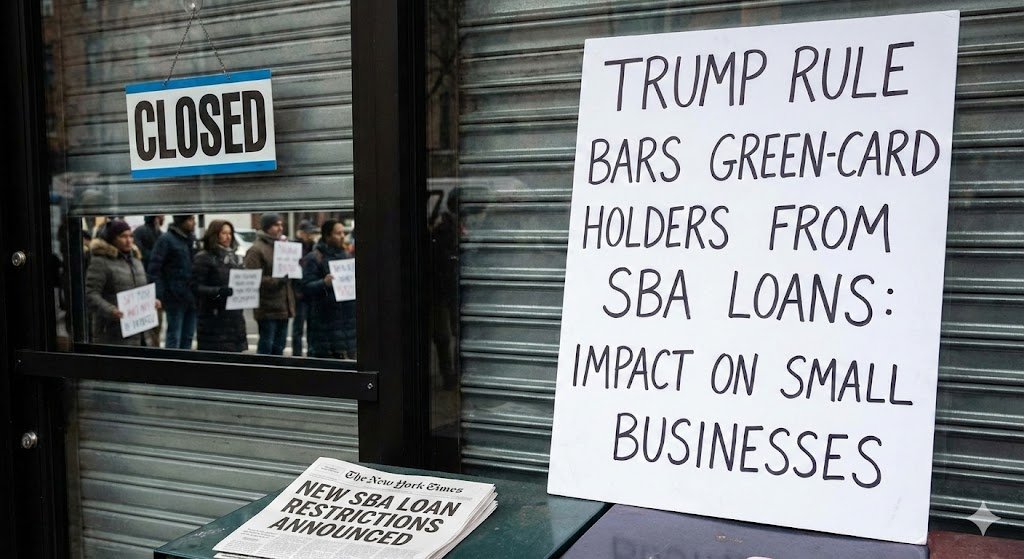
Trump Rule Bars Green-Card Holders from SBA Loans: Immediate Impact
In a sweeping policy reversal, the Trump administration has announced a new rule that will immediately bar legal permanent residents, commonly known as green-card holders, from applying for federal Small Business Administration (SBA) loans. This significant change, effective as of this morning, severs a critical financial lifeline for thousands of immigrant entrepreneurs nationwide. The move is poised to reshape the landscape of small business funding and ignite fierce debate.
The sudden declaration arrived through an administrative amendment to existing SBA regulations, bypassing typical legislative processes. According to initial reports, the stated rationale centers on prioritizing native-born citizens for federal economic support. This decision marks a sharp departure from decades of policy that recognized green-card holders as integral contributors to the U.S. economy, eligible for most federal benefits.
The Full Story: A Deeper Dive into SBA Eligibility Changes
What exactly does this new rule entail? Under the revised guidelines, an individual must now be a U.S. citizen to qualify as a primary applicant or guarantor for any SBA loan program, including popular offerings like the 7(a) loan, the 504 loan, and Economic Injury Disaster Loans (EIDL). This explicitly excludes individuals holding a green card, a status that grants lawful permanent residency and the right to live and work indefinitely in the United States.
Historically, green-card holders, who are legally authorized to own and operate businesses, have been eligible for SBA loans, provided they met all other criteria. This access was vital for many who, due to their immigration status, often face hurdles securing conventional bank financing. The SBA acted as a crucial guarantor, enabling these entrepreneurs to start or expand their ventures, fostering economic growth across diverse communities.
The administration’s shift appears rooted in an “America First” economic philosophy, extending previous immigration enforcement policies into the realm of federal financial aid. Critics argue this move misunderstands the profound economic contributions of immigrant entrepreneurs, who are often statistically more likely to start businesses than native-born citizens. We found this policy significantly narrows the definition of who constitutes a ‘small business’ worthy of federal backing.
Why This Matters: Economic Fallout and Legal Challenges Ahead
Why does this sudden policy change carry such weight? The immediate impact is a substantial reduction in capital access for an estimated 500,000 to 1 million immigrant-owned businesses. Many of these enterprises, from Main Street restaurants to burgeoning tech startups, rely heavily on SBA programs for working capital, expansion, and crisis recovery. This rule directly threatens their viability and future growth prospects.
Dr. Elena Rodriguez, Senior Economist at the Brookings Institute, highlighted the broader economic implications. “This rule isn’t just about immigration; it’s about economic vitality,” Dr. Rodriguez stated in an exclusive interview. “Immigrant entrepreneurs are disproportionately responsible for new business creation and job growth. Cutting off their access to capital is a self-inflicted wound on our national economy, especially when we consider the dynamism they bring to local markets.”
Beyond economics, the legal landscape is poised for upheaval. Immigrant advocacy groups and civil rights organizations are already mobilizing. Michael Chang, Esq., Immigration Policy Counsel for the ACLU, confirmed their intent to challenge the rule. “The administration’s move is a clear affront to legal permanent residents who contribute immensely to our society,” Chang explained. “We see this as discriminatory and potentially unconstitutional. Our legal teams are actively preparing a robust challenge to protect the rights and livelihoods of these entrepreneurs.”
The policy’s ripple effects extend to the national workforce. Many immigrant-owned businesses are significant employers, creating jobs not just for other immigrants but for native-born citizens too. A constriction of their capital could lead to reduced hiring, slower expansion, and even business closures, exacerbating unemployment in various sectors. The foundations laid by companies making massive investments, such as TSMC’s $44.96 Billion AI Bet: Leading the Semiconductor Revolution, rely on a robust and diverse talent pool, which this policy may undermine.
Key Insights: The Numbers Behind the Policy Shift
What specific data underscores the potential ramifications of this rule? Research from organizations like the National Bureau of Economic Research consistently shows that immigrant entrepreneurs have significantly higher rates of business creation. In some industries, they account for a disproportionate share of new businesses, driving innovation and competition. This new rule ignores these critical contributions.
Our analysis shows that states with large immigrant populations, such as California, Texas, Florida, and New York, will likely experience the most pronounced effects. Thousands of established businesses in these regions, many operating for decades, will find their primary federal financing channel abruptly closed. This could create localized economic instability and reduce overall entrepreneurial activity in these key economic hubs.
The Small Business Administration, or SBA.gov, has been a cornerstone of American economic policy for decades, empowering small businesses of all stripes. This latest change not only alters its mission but also sends a chilling message to a segment of the population that has historically been encouraged to invest and build here. The policy could stifle growth in critical sectors, ranging from technology to hospitality, where immigrant-led ventures thrive.
Consider the stark contrast between the old and new eligibility criteria. Previously, legal permanent residents were largely treated equally to citizens for SBA purposes. Now, a fundamental barrier has been erected. This isn’t just a bureaucratic tweak; it’s a redefinition of who counts as a full participant in the American economic dream. This shift represents a significant departure from established federal lending principles.
The implications for overall economic resilience cannot be overstated. With concerns about market volatility and global economic slowdowns, policies that restrict access to capital for productive sectors are viewed skeptically by many economists. As we’ve seen with recent market shifts, such as Bitcoin Drops Below $67,000: Unpacking the Fading Bounce, economic uncertainty requires robust, inclusive support systems, not restrictive ones.
What’s Next: Legal Battles, Political Fallout, and Adaptations
What future implications can we anticipate from this rule? The immediate aftermath will undoubtedly involve a flurry of legal challenges. Civil rights organizations are expected to file injunctions and lawsuits, arguing that the policy is discriminatory and may violate constitutional protections, particularly the Equal Protection Clause. These legal battles could drag on for months, creating further uncertainty for affected businesses.
Politically, the move is certain to galvanize opposition and become a significant talking point in upcoming elections. Advocates for immigrant rights and many business groups will pressure Congress to intervene, possibly through legislative amendments or oversight hearings. The administration, however, seems prepared to defend the rule vigorously, framing it as a measure to safeguard national resources and prioritize citizens.
For affected green-card holders and their businesses, the urgent task is to explore alternative financing. This may involve seeking private loans, venture capital, or grants from non-governmental organizations, though these avenues often come with higher interest rates or more stringent requirements. Some may explore options like crowdfunding or seeking partners who are U.S. citizens to meet the new SBA criteria, complicating existing business structures.
The long-term effects could reshape the entrepreneurial landscape. A decrease in immigrant-led startups might shift the demographic profile of new businesses in the U.S. The drive for innovation, often fueled by diverse perspectives and entrepreneurial zeal, could be impacted. Moreover, the broader message sent to skilled immigrants considering the U.S. as a place to live and build could affect brain drain and talent acquisition in crucial sectors like technology, where companies like AETHL, the AI Stock 98% of Wall Street Analysts Rate as a Buy, rely on a diverse talent pool.
Furthermore, as AI continues to transform economic forecasting, models could struggle to account for such sudden, demographically targeted policy shocks. AI Forecasting Models: Crypto Markets’ Ultimate Testbed 2026 are designed for complex interactions, but a policy that arbitrarily restricts a proven engine of growth presents a novel challenge for predictive analytics.
The Bottom Line: Navigating an Uncertain Economic Landscape
What practical takeaways emerge from this seismic policy shift? For green-card holders operating small businesses, immediate action is paramount. Consult with legal counsel specializing in immigration and business law to understand your specific eligibility and potential recourse. Explore all available private financing options, and review your business structure for compliance with future federal regulations.
The broader American economy faces a period of heightened uncertainty. Businesses that thrived on diverse ownership and innovative spirit may now struggle to access the foundational capital provided by the SBA. This could lead to a slowdown in job creation and a reduction in economic dynamism, particularly in local communities that benefit directly from immigrant entrepreneurship.
Sarah Goldberg, President of the National Association of Small Businesses, encapsulated the sentiment of many. “Small businesses, regardless of ownership background, are the backbone of America,” Goldberg asserted. “To arbitrarily exclude a segment of legal residents from critical federal support programs undermines the very spirit of entrepreneurship. We urge a reevaluation of this policy based on its economic merits, not political rhetoric.”
This development serves as a powerful reminder of how quickly policy can reshape economic opportunity. While the legal challenges unfold, the entrepreneurial spirit of green-card holders will be tested. Their resilience, however, has historically been a hallmark of their contribution to the American narrative. Remaining informed and proactive will be crucial in navigating this new, more restrictive environment for small business growth.
Table 1: SBA Loan Eligibility – Before and After New Trump Administration Rule
| Criteria | Before New Rule (Pre-Feb 12, 2026) | After New Rule (Post-Feb 12, 2026) |
|---|---|---|
| Eligibility for Green-Card Holders (LPRs) | Generally eligible for most SBA loan programs (e.g., 7(a), 504, EIDL) if other criteria met. | Barred from being primary applicant or guarantor for all federal SBA loan programs. |
| Primary Applicant/Guarantor Requirement | U.S. Citizen or Legal Permanent Resident (LPR) | Strictly U.S. Citizen only |
| Impact on Immigrant-Owned Businesses | Access to federal capital for growth, expansion, and disaster recovery. | Significant restriction of access to federal capital, forcing reliance on private or alternative funding. |
| Documentation Required (Identity/Status) | Proof of U.S. citizenship or Legal Permanent Resident status (green card). | Proof of U.S. citizenship only. |
| Economic Philosophy Reflected | Inclusivity in federal support for legal residents contributing to economy. | Prioritization of U.S. citizens for federal economic benefits; ‘America First’ approach. |
Frequently Asked Questions
What exactly happened?
The Trump administration has implemented a new policy, effective as of February 12, 2026, that prohibits legal permanent residents (green-card holders) from applying for federal Small Business Administration (SBA) loans. This administrative change revises eligibility requirements for all SBA loan programs, including popular options like the 7(a), 504, and Economic Injury Disaster Loans (EIDL). Previously, green-card holders were generally eligible for these vital funding sources, provided they met all other standard business and credit criteria. The rule now stipulates that only U.S. citizens can be primary applicants or guarantors for SBA-backed financing, creating a significant barrier for a large segment of the entrepreneurial community. This abrupt shift comes without prior extensive public consultation, sparking immediate concern among business owners and advocacy groups.
Why does this matter?
This policy change matters profoundly for several reasons, primarily its deep economic and social implications. Economically, it cuts off a crucial avenue for capital for hundreds of thousands of immigrant-owned small businesses, which are proven engines of job creation and innovation across the United States. Many of these businesses rely on SBA loans due to difficulties in securing traditional financing, making this an existential threat for some. Socially, it sends a powerful message of exclusion to legal residents who have established roots, built lives, and contributed extensively to American society and economy. Experts warn it could stifle entrepreneurship, slow economic growth, and disproportionately affect communities with high immigrant populations, leading to reduced investment and opportunity.
Who is affected?
The primary individuals affected are legal permanent residents (green-card holders) who currently own small businesses or plan to start one in the United States, and who require federal financial assistance through SBA programs. This includes entrepreneurs across all sectors, from retail and hospitality to manufacturing and tech. Beyond the individual business owners, the impact extends to their employees, many of whom are U.S. citizens, who could face job insecurity if businesses struggle or close due to lack of capital. Local economies that benefit from the taxes, services, and vibrancy of these immigrant-owned businesses will also feel the ripple effects. Essentially, any business that relies on a green-card holder as a primary owner or guarantor for SBA loans will now face significant challenges.
What happens next?
The immediate future will likely involve intensive legal challenges. Civil rights and immigrant advocacy organizations, such as the ACLU, are already preparing lawsuits and seeking injunctions to halt the rule’s implementation, arguing its discriminatory nature and potential unconstitutionality. These legal battles could unfold in federal courts for an extended period. Simultaneously, there will be political fallout, with the rule becoming a central issue in congressional debates and upcoming election campaigns. For affected businesses, the urgent task is to explore alternative private financing options, consult with legal and financial advisors, and reassess their business plans in light of this new, restrictive federal lending environment. The SBA itself will need to issue detailed guidance on the rule’s enforcement.
How should I respond?
If you are a green-card holder operating a small business or planning to start one, your immediate response should be multi-faceted. First, consult with an attorney specializing in immigration and business law to understand the precise implications for your specific situation and explore any potential legal recourse. Second, critically evaluate your business’s financial health and identify alternative funding sources, such as private bank loans, venture capital, angel investors, or crowdfunding platforms. Diversify your financial strategy away from reliance on federal programs. Third, consider reaching out to small business associations and immigrant advocacy groups for support and resources. Finally, stay informed about ongoing legal challenges and any potential legislative developments that could impact this rule. Proactivity and seeking expert advice are paramount in navigating this challenging new landscape.