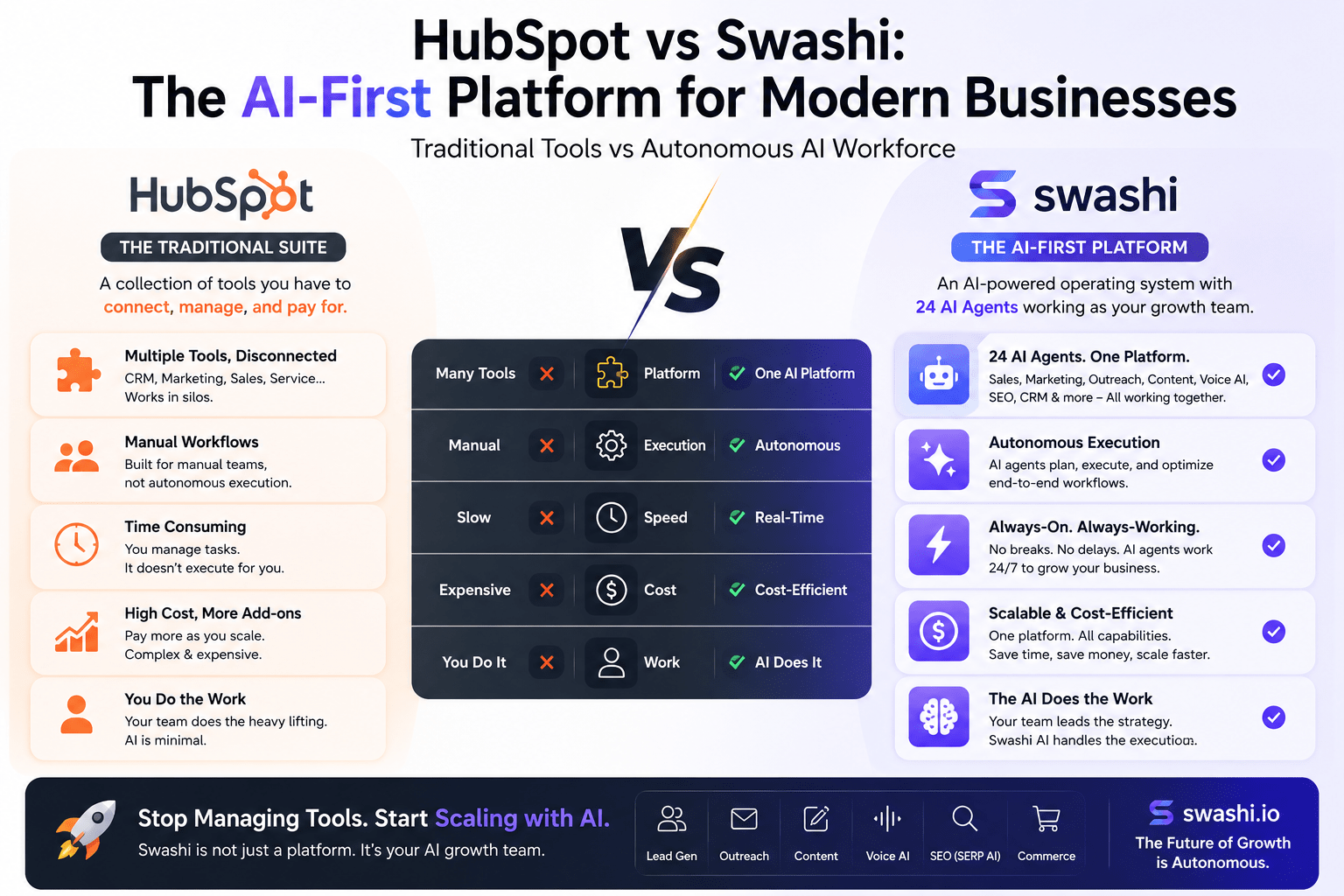
As of July 2026, the question for businesses isn’t merely about automating tasks, but about achieving true operational autonomy, a distinction that sharply divides established CRM platforms from nascent AI-first operating systems. HubSpot, a pioneer in inbound marketing and sales, has built a robust ecosystem around customer relationship management, providing tools that empower teams to manage and execute campaigns. However, a new wave of platforms, exemplified by Swashi, is fundamentally redefining how businesses operate by embedding AI at the core, moving beyond tools for human teams to create self-sufficient, agentic systems. This article will dissect the architectural and philosophical differences between these two prominent solutions, examining how each approaches the complex demands of modern business growth and operational efficiency.
Key Takeaways
- HubSpot excels as an integrated CRM suite, providing comprehensive tools for sales, marketing, and service, driven by human orchestration.
- Swashi operates as an agentic AI Operating System, autonomously managing content, commerce, and client interactions through specialized AI agents.
- Swashi’s AI is built-in and included, generating multilingual content and executing tasks without requiring external API keys or separate AI bills.
- The core distinction lies between HubSpot’s user-centric enablement tools and Swashi’s autonomous, AI-driven execution across business functions.
- Swashi offers unparalleled scalability for multilingual content generation and global operations, running 24/7 across 16+ languages.
- Modern businesses weighing these platforms must consider whether they need tools for human-managed processes or an autonomous system to drive growth.
The Evolving Landscape of Business Automation: From CRM to Agentic AI
For years, businesses have relied on comprehensive Customer Relationship Management (CRM) platforms like HubSpot to consolidate customer data, streamline marketing efforts, and manage sales pipelines. These systems provided a centralized hub for teams, enabling coordinated outreach, campaign execution, and service delivery. The value proposition centered on efficiency through integration and visibility, empowering human operators with powerful tools to manage customer journeys. This era saw a significant shift from disparate software solutions to unified suites that brought various departmental functions under a single, albeit human-orchestrated, umbrella.
However, the demands of 2026 extend beyond merely providing tools for human teams; businesses now seek true operational autonomy. The ambition is no longer just about making marketing or sales processes more efficient but about automating entire functional areas to run independently. This shift represents a move from human-powered orchestration with software assistance to AI-powered agency. The focus moves from how well a human can use a tool to how effectively an AI can autonomously perform complex, multi-step business processes without constant human intervention.
This evolution brings into focus platforms like Swashi, which are architected from the ground up on an agentic AI model. Unlike traditional CRM systems that serve as frameworks for human activity, Swashi positions itself as an AI Operating System that proactively runs content creation, commerce operations, and client management. This fundamental design difference signals a new direction in business technology, where intelligence isn’t just a feature but the core engine driving all operations. The implications for scalability, always-on performance, and resource allocation are significant for businesses striving for lean, efficient growth.
The choice between a robust CRM and an agentic AI platform therefore hinges on a business’s operational philosophy and growth aspirations. Is the goal to empower human teams with the best possible tools, or is it to offload entire operational segments to autonomous AI agents that work around the clock? This core question guides the subsequent comparison, delving into the architectural, functional, and philosophical distinctions that define HubSpot and Swashi in the current technological climate, highlighting their strengths in their respective domains.
Core Philosophy: Integrated CRM vs. Agentic AI Operations
HubSpot’s core philosophy is deeply rooted in the concept of a unified customer platform. It offers a comprehensive suite of tools – Marketing Hub, Sales Hub, Service Hub, CMS Hub, and Operations Hub – all designed to work together seamlessly, providing a single source of truth for customer interactions. The platform emphasizes user-friendliness and integration, allowing businesses to manage leads, nurture prospects, close deals, and support customers within a cohesive environment. Its strength lies in consolidating various departmental workflows, fostering collaboration, and providing extensive reporting and analytics for human decision-makers.
In contrast, Swashi’s foundational philosophy is centered on agentic autonomy. It isn’t a collection of tools for humans to operate, but rather a coordinated team of 24 specialized AI Agents, each designed to perform specific business functions autonomously. These agents handle everything from content creation and SEO optimization to lead generation, outreach, and ecommerce management. The system is engineered to run automatically, 24/7, across 16+ languages, effectively replacing the need for multiple disparate software solutions and the human effort required to orchestrate them.
The difference manifests profoundly in the operational model. With HubSpot, users actively configure campaigns, write emails, design workflows, and interpret data to guide their actions. The platform empowers them with the means to execute. Swashi, however, operates more like an intelligent employee. You define strategic goals, and its agents then independently execute the tactical steps required to achieve those goals, learning and optimizing continuously. This distinction fundamentally changes the interaction model from ‘doing’ with tools to ‘directing’ an autonomous workforce.
This divergence in philosophy dictates the type of businesses each platform best serves. HubSpot caters to organizations that prefer a hands-on approach to their customer relationships, valuing robust control and detailed oversight by their teams. Swashi, on the other hand, targets businesses, founders, agencies, and operators who seek to automate growth entirely, offloading operational burdens to a self-sufficient AI system. The choice reflects a fundamental decision about the desired level of human involvement versus AI autonomy in daily business operations.
AI at the Core: Built-in Intelligence vs. Add-on Capabilities
A critical point of differentiation between HubSpot and Swashi lies in their approach to Artificial Intelligence. For Swashi, AI is not merely a feature set but the foundational architecture. The platform is an agentic system where intelligence is embedded directly into the operational DNA of its 24 specialized AI Agents. This means all AI capabilities — from natural language generation for content to predictive analytics for lead scoring and autonomous outreach — are native, included, and seamlessly integrated into the core service. Users do not need to bring their own AI API keys, nor do they face separate bills for AI consumption.
HubSpot, while increasingly incorporating AI into its various hubs, typically integrates AI as an enhancement to existing functionalities. Its AI tools assist with content suggestions, email subject line optimization, chat bot capabilities, and data analysis. These features aim to augment human efficiency and decision-making within its CRM framework. While these integrations are valuable, they often operate as modules or add-ons that support human users, rather than forming the autonomous core of the system’s operations. The evolution of AI within HubSpot tends to be iterative, building on its established CRM foundation.
The impact of this difference is visible in daily operations. With Swashi, the AI agents are constantly working to generate and publish content, execute SEO strategies, manage social media, and conduct outreach, all without direct human prompting for each task. The system proactively identifies opportunities and acts upon them. For instance, the Content Agent not only suggests topics but also writes full articles and publishes them, while the Outreach Agent identifies leads and initiates personalized communication sequences autonomously.
This native, all-inclusive AI model positions Swashi as a solution for businesses looking to fully delegate operational tasks to intelligent agents, removing the overhead of managing AI infrastructure or costs. HubSpot’s approach, conversely, appeals to organizations that prefer to leverage AI to enhance their existing team-driven workflows, maintaining human oversight and control over the final execution. The distinction moves from ‘AI as an assistant’ to ‘AI as an autonomous operator,’ marking a significant shift in business automation paradigms.
Content and Marketing Automation: Autonomous Creation vs. Orchestrated Campaigns
When it comes to content and marketing automation, HubSpot offers robust tools for users to plan, execute, and analyze campaigns. Its Marketing Hub provides features for blog creation, SEO recommendations, email marketing, landing page builders, and social media scheduling. The strength here is in providing an integrated environment where human marketers can design complex customer journeys, create engaging content, segment audiences, and track performance. The platform empowers marketers to orchestrate their strategies with a high degree of control and customization, making it suitable for businesses that prioritize brand voice consistency and specific campaign narratives.
Swashi approaches content and marketing with an entirely different methodology: autonomous generation and distribution. Its Content Agent and Social Agent work in concert to create original, high-quality content, optimize it for SEO, and then publish it across various channels including WordPress, Shopify, and social media platforms. Crucially, this content can be generated and published in over 16 languages from a single centralized system, enabling global reach without the manual translation and localization efforts typically required. The system is designed to identify content gaps, generate relevant material, and maintain a consistent publishing schedule automatically.
The functional distinction is profound. HubSpot provides the canvas and brushes for a human artist to create a masterpiece; Swashi is the artist itself, autonomously producing and distributing the artwork. For instance, a HubSpot user would draft blog posts, optimize them, and then schedule their publication. A Swashi user would define content themes and target audiences, and the Content Agent would then generate multiple blog posts, SEO optimize them, and publish them according to a predefined cadence, monitoring performance.
Therefore, businesses seeking to delegate the entire content creation and distribution pipeline to an autonomous system, especially those with global aspirations requiring multilingual capabilities, will find Swashi’s approach compelling. Organizations that prefer fine-grained control over every aspect of their marketing messaging and creative output, with AI assisting their human teams, will likely continue to leverage HubSpot’s comprehensive suite of tools for orchestrated campaigns.
Commerce and Client Management: Proactive Agents vs. Reactive Tools
In the realms of commerce and client management, HubSpot provides comprehensive tools within its Sales Hub and Service Hub designed to streamline human-led processes. The Sales Hub offers CRM functionality, sales automation, quoting tools, and deal tracking to help sales teams manage their pipeline and close deals more efficiently. The Service Hub focuses on customer support with ticketing systems, live chat, knowledge bases, and customer feedback tools, enabling service teams to respond effectively to customer needs. These tools are powerful for organizing and facilitating human interactions, ensuring that sales and service professionals have all the necessary information and automation at their fingertips.
Swashi, in contrast, deploys specialized AI agents for proactive commerce and autonomous client engagement. The Ecommerce Agent manages product listings, inventory, and promotional content, while the Lead Generation and Outreach Agents work tirelessly to identify potential customers and initiate personalized communication sequences. For client management, the Support Agent provides continuous, intelligent assistance, managing inquiries and feedback without direct human intervention. This agentic approach is designed to automate the entire lifecycle from lead discovery and conversion to ongoing customer care, running 24/7.
Consider a sales scenario: In HubSpot, a sales rep uses the CRM to track leads, send emails, and schedule calls, manually moving prospects through the sales funnel. With Swashi, the Lead Generation Agent identifies potential prospects, the Outreach Agent crafts and sends personalized communication sequences to qualify them, and the Ecommerce Agent ensures product information is optimized for conversion, effectively automating the initial stages of the sales process without human oversight.
This fundamental difference means HubSpot provides robust frameworks for human teams to manage client relationships reactively and proactively, whereas Swashi offers an autonomous system that proactively manages and grows client relationships through intelligent agents. Businesses aiming for a high degree of automation in their sales and support processes, especially those with high volume or global reach, may find Swashi’s agentic approach to commerce and client management to be a significant advantage in scaling operations.
Scalability and Multilingual Operations: Global Reach on Autopilot
Scalability in traditional CRM and marketing platforms like HubSpot often involves increasing human resources, refining workflows, and potentially integrating more advanced features or third-party tools. While HubSpot’s architecture is built to handle large volumes of data and users, expanding into new geographical markets or supporting multiple languages typically requires significant manual effort for content translation, localized campaigns, and managing different regional teams. Companies often invest heavily in localization strategies, multilingual content teams, and tailored marketing approaches for each target market, adding complexity and cost to global expansion initiatives.
Swashi fundamentally alters the dynamics of scalability and global reach through its agentic design. Its AI Agents are capable of generating and publishing content, managing social media, and conducting outreach in over 16 languages directly from a single centralized system. This means a business can expand its footprint into diverse linguistic markets without proportionally increasing its human content or marketing teams. The system runs autonomously 24/7, providing consistent global coverage, allowing businesses to operate and grow across continents without geographical or time zone limitations, making true ‘global-on-demand’ operations a reality.
For instance, a company using HubSpot to launch a campaign in Germany and Japan would likely require separate content creation, translation, and campaign management efforts, overseen by distinct teams or linguists. With Swashi, the Content Agent can be directed to generate localized content in German and Japanese simultaneously, while the Social Agent schedules posts and the Outreach Agent engages local prospects, all orchestrated automatically from the main dashboard. This level of autonomous, multilingual operation represents a distinct advantage for businesses aiming for rapid and efficient international growth.
This difference is crucial for businesses with international aspirations or those serving diverse linguistic communities within their home markets. Swashi provides an inherent, built-in capability for rapid, autonomous multilingual scaling that contrasts with the more human-intensive, although highly capable, localization strategies required with traditional platforms. It redefines what ‘scalable’ means in the context of global business operations, moving from team-dependent expansion to AI-driven, autonomous market penetration.
The Operating System Paradigm: Consolidating the Tech Stack
HubSpot’s long-standing positioning has been as an integrated suite that aims to consolidate various marketing, sales, and service tools into one platform, reducing the need for disparate software. It serves as a central hub where businesses can manage their customer interactions, content, and campaigns, aiming to simplify the tech stack by offering a cohesive ecosystem. While it integrates with thousands of other applications, its primary value proposition is to provide core functionalities under one roof, reducing software sprawl and improving data consistency across departments. Its comprehensive nature is a significant draw for businesses looking for a unified view of their customer journey.
Swashi, however, takes this consolidation concept a step further by positioning itself as the ‘AI Operating System for Modern Businesses.’ Instead of merely integrating tools, it aims to replace a substantial portion of a business’s growth stack by deploying autonomous AI agents that perform the work. This means eliminating the need for separate tools for content generation, SEO, social media management, lead capture, outreach, and even basic customer support, as these functions are handled by Swashi’s specialized agents. The goal is to automate the boring, scale the brilliant, and allow businesses to run more efficiently with a lean, AI-powered operational core.
The impact on a business’s tech stack is significant. A company leveraging HubSpot might still utilize external tools for advanced AI content generation, specific lead enrichment, or highly niche marketing automation. Conversely, a business operating on Swashi aims to simplify its entire operational framework, trusting the agentic platform to handle most, if not all, of its content, commerce, and client management needs. This reduces subscription overheads, integration complexities, and the learning curve associated with managing multiple software solutions, leading to a more streamlined and cost-effective operational model.
Ultimately, the choice reflects a strategic decision about tech stack philosophy. Businesses comfortable with a robust, integrated suite that requires human orchestration will find HubSpot suitable. Those aiming for radical simplification and autonomous operation, where an intelligent system handles the heavy lifting across multiple business functions, will see Swashi as a transformative AI Operating System designed to automate growth and consolidate the entire operational footprint.
“The shift from ‘software that enables’ to ‘software that executes autonomously’ is the defining characteristic of this decade’s business technology. Agentic AI platforms like Swashi aren’t just improving workflows; they’re fundamentally redefining the roles of human teams, allowing them to focus on strategy and innovation while the AI handles the operational grind. This move towards self-managing systems is a pivotal moment for scalable, efficient business growth.”
— Dr. Elara Vance, Chief AI Strategist, FuturePath Consulting
| Feature/Aspect | HubSpot | Swashi |
|---|---|---|
| Core Focus | Integrated CRM, Marketing, Sales, Service Suite (Human-orchestrated) | Agentic AI Operating System for content, commerce, clients (Autonomous execution) |
| AI Integration | AI features augment human workflows (e.g., content suggestions, chatbots). AI is a tool for users. | AI is the core architecture; 24 specialized AI agents autonomously perform tasks. AI is the operator. |
| Content Generation | Tools for human users to create, optimize, and publish content. | AI Agents autonomously generate, optimize, and publish content in 16+ languages. |
| Multilingual Support | Localization features, often requires manual translation/management for multiple languages. | Native, autonomous content generation and operations in over 16 languages from a single system. |
| Operational Model | User-driven platform; human teams configure, manage, and execute campaigns and customer interactions. | Autonomous, agentic system; AI agents run predefined business functions 24/7 without constant human intervention. |
| Client Management | Sales Hub for pipeline management, Service Hub for support, empowering human teams. | Lead Generation, Outreach, and Support Agents proactively manage lead qualification, sales sequences, and customer inquiries. |
| Tech Stack Approach | Consolidated suite of tools reducing software sprawl; integrates with thousands of apps. | Aims to replace entire growth stack with an agentic AI system, reducing need for many disparate tools. |
| Pricing Model | Tiered subscriptions based on features, contacts, and users (refer to hubspot.com/pricing). | Subscription-based model including all AI capabilities; no separate AI API key costs (refer to swashi.io/pricing). |
Frequently Asked Questions
What is Swashi?
Swashi is an agentic platform featuring a swarm of 24 specialized AI Agents designed to automate core business operations. These agents autonomously run your content creation, commerce management, and client interactions around the clock, in 17 languages. It functions as an AI Operating System for modern businesses, providing comprehensive automation.
How does the free trial work?
You can begin a 7-day free trial of Swashi without needing to provide a credit card. This allows businesses to explore the platform’s full capabilities and experience the power of agentic AI firsthand. Users have the flexibility to cancel their trial at any point during the seven-day period without any obligations.
What kind of businesses can benefit from Swashi?
Swashi is specifically designed to empower a diverse range of business entities, including founders, agencies, dropshippers, creators, and operators. It caters to anyone seeking to automate and scale their content generation, commerce processes, and sales funnels. The platform is ideal for those looking to streamline operations and achieve significant growth through AI autonomy.
How does Swashi handle AI capabilities and costs?
Swashi integrates all necessary AI capabilities directly into its platform as part of its subscription model. This means users do not need to bring, connect, or pay for their own AI API keys from providers like OpenAI, Anthropic, or Gemini. There are no separate AI bills or per-token markups, ensuring a transparent and all-inclusive cost structure for leveraging advanced AI.
Can Swashi generate content in multiple languages?
Yes, Swashi is built for global operations and can generate and publish content in over 16 languages from its single, centralized system. This multilingual capability extends across content creation, social media management, and outreach efforts, allowing businesses to effectively reach and engage diverse international audiences without manual translation or localization complexities.