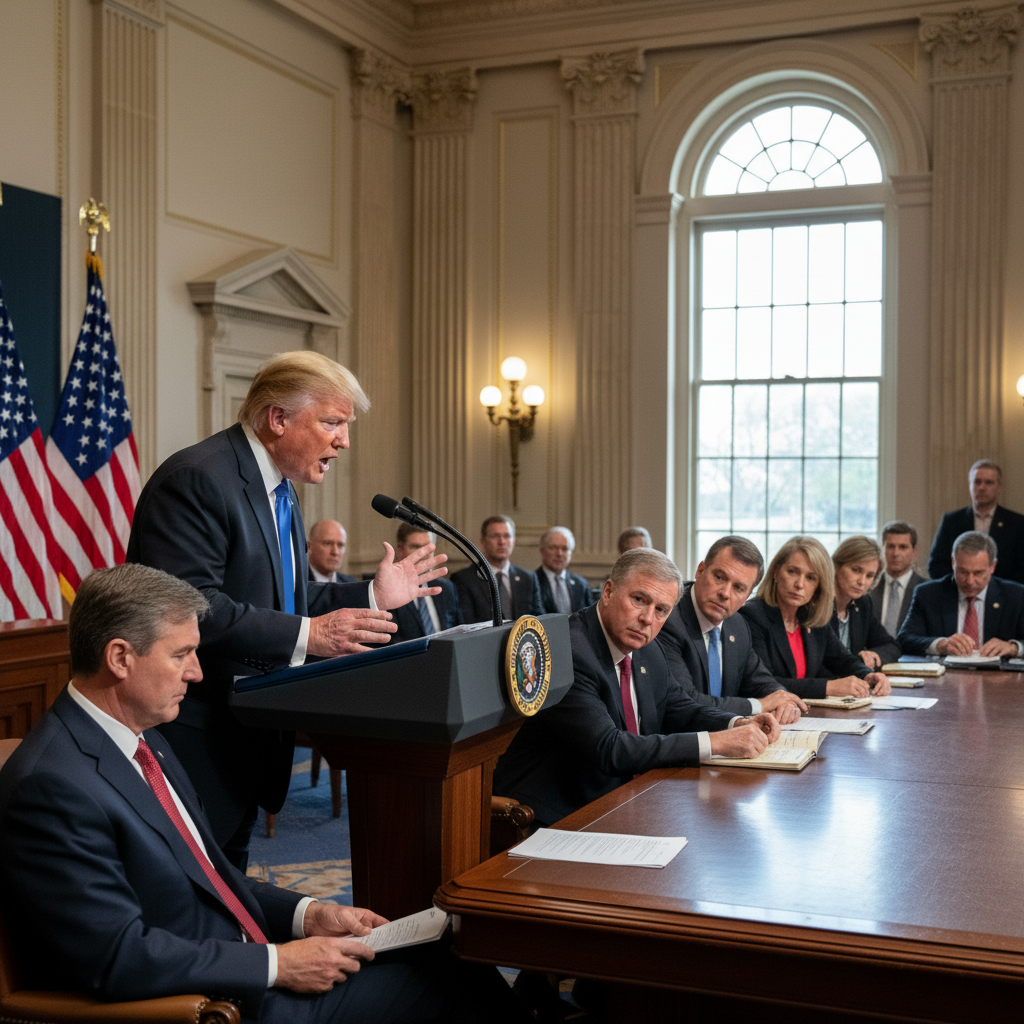
In the preceding year, a significant political episode unfolded as President Donald Trump publicly chastised Senate Republicans. This stern rebuke followed a bipartisan Senate vote aimed at limiting presidential war powers concerning Iran, a legislative move that challenged executive authority. The President’s discontent was notably underscored by his decision to abruptly cancel the signing of a separate, routine appropriations bill, directly linking it to the perceived disloyalty of his party members. This confluence of events not only highlighted deep divisions within the Republican ranks but also reignited long-standing constitutional debates surrounding the balance of power between the executive and legislative branches in matters of international conflict, marking a pivotal moment in recent American political history and setting a tense tone for future legislative engagements.
Key Takeaways
- President Trump issued a severe public rebuke to Senate Republicans following a bipartisan vote on Iran war powers.
- The Senate’s resolution sought to reclaim congressional authority on military engagement, particularly concerning Iran.
- A symbolic cancellation of a bill signing amplified President Trump’s displeasure, tying legislative support to loyalty.
- The incident exposed internal fissures within the Republican Party, challenging party unity and leadership.
- It reignited constitutional discussions on the allocation of war-making powers between the President and Congress.
- The fallout had implications for future foreign policy decisions and legislative oversight mechanisms.
- The event underscored the political leverage exercised by the executive branch in response to perceived congressional defiance.
The Context of Congressional Discontent on War Powers
Long before the direct confrontation over Iran, a palpable dissatisfaction had been growing within Congress regarding the extent of presidential war-making authority. Members from both major parties increasingly expressed concerns that the executive branch had accumulated excessive power to commit U.S. forces to military actions abroad without explicit legislative approval. This sentiment was particularly acute following years of military interventions and deployments in the Middle East, often initiated under broad authorizations passed decades prior. Legislators argued for a reassertion of their constitutional role, emphasizing the importance of checks and balances in decisions carrying profound national and international consequences, preparing the ground for legislative actions like the one that sparked the President’s reaction.
The push for greater congressional oversight was not merely a partisan maneuver; it reflected a genuine desire across the political spectrum to restore legislative primacy in declarations of war. Many lawmakers believed that the erosion of this power diminished the democratic process, leaving vital decisions to a single individual rather than the deliberative body intended by the Constitution. This underlying tension frequently manifested in calls for new authorizations for the use of military force or, conversely, for resolutions that explicitly limited presidential actions. The environment was therefore ripe for a legislative challenge that, regardless of its immediate success, would inevitably draw a strong response from the executive branch, guarding its perceived prerogatives jealously.
Historically, the debate over war powers has oscillated, with periods of strong congressional assertion followed by executive expansion. Recent administrations, irrespective of party, have often relied on interpretations that grant significant latitude in deploying military force to protect national interests or respond to perceived threats. However, a growing cohort in Congress felt that this tradition had shifted too far, bypassing essential constitutional mechanisms designed to ensure public and legislative consensus before engaging in conflict. This deep-seated conviction provided the impetus for the bipartisan Senate effort, framing it not just as a political act but as a defense of foundational governance principles against executive overreach in foreign policy.
The specific concern regarding Iran, which served as the flashpoint for this particular legislative action, stemmed from escalating tensions and several high-profile incidents involving both nations in the preceding months. Lawmakers feared an inadvertent slide into a broader conflict, potentially initiated without the full consent or debate of Congress. The resolution, therefore, aimed to impose a clear legal framework requiring explicit congressional authorization for any offensive military action against Iran. This attempt to draw a line in the sand, driven by a desire to prevent unilateral executive action, directly challenged President Trump’s approach to foreign policy and ultimately led to his vehement public response, exposing underlying power dynamics.
The Senate’s Bipartisan Stand on Iran War Powers
The Senate’s decisive vote on the Iran war powers resolution marked a rare moment of bipartisan unity on a critical foreign policy issue, standing in stark contrast to the often-divided legislative landscape. Spearheaded by a coalition of senators from both Republican and Democratic parties, the resolution sought to reinforce the War Powers Act of 1973, stipulating that the President must seek congressional approval before engaging in sustained military action against Iran. This move was viewed by many as an essential safeguard against what they considered potentially escalatory or unilateral executive decisions that could draw the United States into a broader conflict without adequate national deliberation or legislative oversight, reflecting a growing unease.
A notable number of Republican senators joined their Democratic colleagues, signifying a fracture in traditional party loyalty on matters of executive authority. These Republicans often voiced concerns about the long-term implications of unchecked presidential power, particularly when it came to military engagements. Their support for the resolution was framed as an affirmation of the Constitution’s framers’ intent, ensuring that the heavy burden of war initiation rests with the elected representatives of the people. This cross-party collaboration demonstrated a shared conviction that congressional voice was imperative in decisions of war and peace, irrespective of who occupied the Oval Office at the moment.
The specific language of the resolution was meticulously crafted to avoid directly condemning any previous executive actions, instead focusing on prospective limitations. It aimed to establish a clear procedural requirement for future military operations against Iran, ensuring that any prolonged conflict would necessitate congressional authorization, thereby aligning with constitutional directives. Proponents argued this was not an act of defiance but an exercise of constitutional duty, emphasizing that a robust debate and vote by Congress would lend greater legitimacy and national consensus to any potential military involvement. Such legislative precision sought to carve out a definitive role for the legislative branch.
Despite strong opposition from the White House, including direct lobbying efforts and public statements urging senators to vote against it, the resolution garnered sufficient support to pass the Senate. The outcome underscored the depth of congressional concern over war powers and the willingness of a significant segment of the Republican Party to prioritize institutional checks and balances over strict party alignment. This vote, therefore, represented more than a policy disagreement; it was a fundamental reassertion of legislative prerogative in foreign policy decision-making, setting a precedent that deeply irritated the executive branch and triggered a very public and sharp retaliation from the President himself, signaling ongoing tensions.
President Trump’s Public Rebuke and Allegations of Disloyalty
Following the Senate’s passage of the Iran war powers resolution, President Trump reacted with characteristic vehemence, unleashing a barrage of criticism via public statements and social media. His remarks were not just condemnations of the resolution’s content but highly personal attacks on the Republican senators who voted in favor of it. He cast their votes as acts of disloyalty, implying that their actions undermined his foreign policy agenda and provided comfort to adversaries. This public shaming aimed to exert maximum pressure on the dissenting Republicans, framing their legislative independence as a betrayal of party principles and presidential leadership, demanding absolute allegiance to his directives.
The President’s rhetoric frequently portrayed the bipartisan vote as an affront to his authority and a direct challenge to his ability to protect national interests. He argued that the resolution hampered his executive powers as Commander-in-Chief, making the nation vulnerable and sending a message of weakness to foreign adversaries. This narrative sought to rally his base and put dissenting Republicans on the defensive, forcing them to justify their votes not just to their colleagues but to the broader electorate. His public statements often included strong suggestions that their political careers could suffer consequences for their perceived insubordination, creating a hostile environment for those who chose to deviate.
Specific senators, particularly those who had previously shown some independence from the White House, found themselves singled out for harsh criticism. The President’s direct targeting of individual members of his own party was an unprecedented display of internal political warfare, designed to enforce discipline and discourage future deviations from his policy stances. The accusations of disloyalty resonated deeply within the Republican Party, where unity around the President was often seen as a prerequisite for political advancement. This strategy aimed to make any future bipartisan cooperation on contentious issues a much more politically costly endeavor for Republican lawmakers.
The intensity of the President’s rebuke sent clear signals throughout Washington: opposition, even on constitutional grounds, would not be tolerated quietly, particularly when it involved foreign policy and national security. The incident served as a stark reminder of the unique political dynamics of the era, where traditional party structures and legislative decorum often took a backseat to direct presidential engagement and public pressure. The fallout from this episode had a chilling effect on some, while solidifying the resolve of others, leaving the Republican Party grappling with the implications of an increasingly centralized and personality-driven leadership that demanded absolute loyalty to the executive branch.
The Canceled Bill Signing and Its Broader Implications
In a dramatic escalation of his displeasure, President Trump unexpectedly canceled the public signing of an unrelated, significant appropriations bill, directly linking the decision to the Senate’s Iran war powers vote. This move, highly unusual for a routine legislative process, served as a tangible and highly visible expression of his anger. The appropriations bill, which had broad bipartisan support and was crucial for funding various government operations, was a measure that typically would have been celebrated by the administration. By withholding the symbolic public signing, the President leveraged a critical legislative act as a tool for political retribution and an unmistakable warning to Congress.
The cancellation sent ripples through Washington, signaling that the President was willing to disrupt even broadly supported legislative functions to punish perceived disloyalty within his own party. It transformed a routine act of governance into a stark reminder of executive power, illustrating how presidential approval extended beyond mere policy alignment to encompass a broader expectation of political fealty. This tactic went beyond mere rhetorical criticism, impacting the ceremonial recognition of legislative achievement and implying potential downstream consequences for future congressional initiatives. It was an unmistakable demonstration of the President’s willingness to disrupt established norms for political gain, further straining the relationship between branches.
For the Republican senators who had voted for the Iran resolution, the canceled signing was not merely a symbolic gesture but a public humiliation, underscoring the political cost of defying the White House. It communicated unequivocally that their legislative accomplishments, even those unrelated to the contentious vote, could be held hostage by the President’s personal grievances. This amplified the internal pressure on Republicans to conform to the President’s agenda, potentially making them reconsider future bipartisan efforts that might run contrary to executive wishes. The message was clear: loyalty to the President’s personal objectives carried more weight than institutional legislative duties, at least in the short term, exacerbating party divisions.
Beyond the immediate political theater, the incident raised significant questions about the decorum and functionality of legislative processes. Critics argued that politicizing a routine bill signing undermined democratic institutions and fostered an environment of transactional governance, where legislative wins could be arbitrarily denied based on unrelated political disagreements. The act further blurred the lines between policy debate and personal loyalty tests, contributing to a climate of heightened political tension and unpredictability. This strategic use of executive power, while effective in conveying displeasure, contributed to an erosion of trust and established protocols between the legislative and executive branches, hindering future collaborative efforts significantly.
Republican Division and Internal Party Dynamics
The Iran war powers vote and subsequent presidential rebuke illuminated the deep-seated divisions simmering within the Republican Party, highlighting a struggle between traditional conservative principles and unwavering loyalty to the executive branch. A contingent of Republican senators, often considered establishment figures or constitutionalists, consistently demonstrated a willingness to challenge the President on issues of governance and foreign policy. Their support for the resolution reflected a belief that defending congressional prerogatives was paramount, even if it meant diverging from the party leader, signaling a deeper ideological split that frequently surfaced on key legislative votes.
Conversely, a significant portion of the Republican caucus maintained steadfast support for President Trump, often prioritizing party unity and the advancement of his agenda above all else. For these members, aligning with the President was not just a political calculation but an affirmation of their voter base’s sentiments and a strategic move to maintain power. The President’s public berating of dissenters served to reinforce this dynamic, placing immense pressure on wavering Republicans to fall in line and discouraging any future acts of legislative independence, effectively creating a loyalty test that permeated all levels of party engagement and decision-making.
The episode forced many Republican leaders into a difficult position, caught between defending their colleagues’ constitutional duties and maintaining party cohesion in the face of presidential attacks. The internal conflict underscored the evolving nature of the Republican Party, moving away from conventional ideological alignment towards a more personality-driven political force. This shift often left traditional institutionalists feeling marginalized, while emboldening those who saw their political fortunes tied directly to the President’s approval. The resulting friction had profound implications for party strategy and messaging, particularly as major legislative initiatives approached, demanding a united front.
The long-term effects of this internal strife within the Republican Party were visible in subsequent legislative sessions. The incident contributed to a climate where dissent became riskier, potentially impacting re-election campaigns or committee assignments. It solidified a pattern where presidential approval became a central metric for many Republican lawmakers, overshadowing traditional legislative accomplishments or bipartisan cooperation. This dynamic continued to shape the Republican Party’s approach to policy, foreign relations, and even its internal leadership selections, creating an environment where deference to the executive often outweighed independent legislative judgment, leading to reduced internal debate on key issues.
Constitutional Powers and Executive Authority in Focus
The clash over the Iran war powers resolution brought into sharp relief the perennial constitutional debate regarding the allocation of war-making powers between the executive and legislative branches. The U.S. Constitution grants Congress the power to declare war, raise and support armies, and provide for a navy, while designating the President as Commander-in-Chief. This division was intentionally designed by the framers to prevent unilateral executive action in matters of conflict, ensuring that the decision to engage in warfare reflects the collective will of the nation’s representatives, rather than the singular discretion of the President, a critical balance of power.
However, over decades, presidential administrations have incrementally expanded the scope of executive authority in foreign policy and military engagement, often citing implied powers, urgent national security interests, or broad interpretations of existing authorizations. This gradual expansion has led to numerous instances where presidents have deployed military force without a formal declaration of war, provoking consistent, albeit often ineffectual, challenges from Congress. The Iran war powers resolution was a direct attempt by the legislative branch to reclaim some of that lost ground, seeking to impose a clearer legislative mandate on future executive actions that could lead to military conflict in the region.
President Trump’s vociferous response emphasized his view of expansive executive power, asserting that as Commander-in-Chief, he possessed the inherent authority to make rapid decisions to protect U.S. interests without being constrained by legislative processes he perceived as cumbersome or politically motivated. This perspective highlighted a fundamental disagreement on the interpretation of constitutional text and historical precedent, pushing the boundaries of what constitutes legitimate executive action in foreign policy. His administration consistently argued for a strong, decisive executive, unencumbered by what they considered unnecessary congressional interference, especially in sensitive national security matters requiring swift action and secrecy.
The episode served as a powerful reminder that while the theoretical division of war powers is enshrined in the Constitution, its practical application remains a contentious area, subject to political will and institutional struggles. Each branch vigorously defends its perceived authority, leading to cyclical confrontations that shape the operational realities of American foreign policy. The Senate’s vote and the President’s reaction underscored that this debate is far from settled, with significant implications for future presidential administrations and congressional efforts to assert their constitutional role in decisions of war and peace, continuing a long-standing pattern of inter-branch contention and negotiation.
Ramifications for Foreign Policy and Congressional Oversight
The aftermath of the Iran war powers vote and President Trump’s strong rebuke extended beyond domestic political squabbles, carrying significant ramifications for U.S. foreign policy and the future of congressional oversight. Internationally, the incident may have sent mixed signals regarding American policy consistency and decision-making processes. Allies might have viewed the internal discord as a sign of instability or unpredictability in U.S. foreign relations, potentially leading them to reassess their strategic partnerships. Adversaries, conversely, might have perceived an opportunity to exploit perceived divisions within the American government, influencing their own calculations and actions in volatile regions.
Domestically, the event further complicated Congress’s role in foreign policy. While the Senate vote represented a legislative attempt to assert authority, the President’s forceful reaction and the subsequent political costs for dissenting Republicans may have a chilling effect on future congressional oversight efforts. Lawmakers might become more hesitant to challenge executive decisions on national security, fearing presidential retribution or internal party ostracization. This could diminish Congress’s ability to provide a robust check on executive power, potentially leading to less debated and scrutinized foreign policy choices, which carries inherent risks for long-term national interest, fostering a climate of deference.
For specific regions, particularly the Middle East, the political fallout could have direct implications. The resolution aimed to de-escalate tensions with Iran by requiring congressional input, but the ensuing political turmoil might have been interpreted differently by regional actors. The perceived internal weakness or disunity could alter the strategic calculus of nations in the area, potentially leading to increased assertiveness or miscalculation. The U.S.’s ability to project a unified and coherent foreign policy message is paramount in such complex environments, and this incident demonstrably undermined that perception, making diplomatic efforts more challenging and less predictable for all involved parties.
Ultimately, the episode underscored the delicate balance required for effective foreign policy: a strong executive capable of decisive action, paired with a robust legislative branch providing essential oversight and debate. When that balance is disrupted by internal political battles, the effectiveness and credibility of U.S. foreign policy can suffer. The incident prompted renewed calls from some quarters for clearer, more enduring frameworks for war powers that transcend individual administrations, aiming to insulate critical national security decisions from transient political disputes, yet the challenge of achieving such consensus remains a persistent hurdle in the American political system, reflecting ongoing systemic friction.
“The events surrounding the Iran war powers vote were a stark illustration of the executive’s formidable political leverage, even when faced with bipartisan legislative action. While Congress possesses clear constitutional authority, a President’s willingness to weaponize political capital, such as canceling bill signings or publicly shaming party members, profoundly impacts the legislative calculus. It transforms a constitutional debate into a test of loyalty, making it significantly harder for individual lawmakers to uphold institutional prerogatives without facing severe political repercussions. This dynamic fundamentally shifts the balance in practice, irrespective of what the founding documents dictate in theory, setting a concerning precedent for future inter-branch relations and highlighting the enduring struggle for power in Washington’s complex political arena.”
— Dr. Eleanor Vance, Constitutional Law Professor, Georgetown University
| Aspect | Executive Power Perspective (President Trump’s View) | Legislative Power Perspective (Senate Resolution Proponents) |
|---|---|---|
| Basis of Authority | Inherent powers of Commander-in-Chief; Article II of Constitution; swift action for national security. | Congressional power to declare war; Article I of Constitution; War Powers Act of 1973. |
| Decision-Making Speed | Necessity for rapid, unencumbered action in dynamic international environments. | Deliberative process ensures public and legislative consensus; avoids rash decisions. |
| Accountability | Accountable to the electorate through presidential elections. | Accountable to the electorate through elected representatives and their votes on war. |
| Foreign Policy Messaging | Unified, decisive executive image projected to allies and adversaries. | Broad national consensus strengthens legitimacy and international support for actions. |
| Scope of Action | Ability to deploy military force broadly to protect U.S. interests without pre-authorization. | Requires explicit congressional authorization for sustained or offensive military engagements. |
| Party Loyalty | Expectation of party members’ support for presidential foreign policy agenda. | Duty to uphold constitutional checks and balances, even when it means challenging the executive. |
| Impact of Dissent | Perceived as undermining executive authority, potentially encouraging adversaries. | Essential for preventing overreach and ensuring comprehensive national debate on war. |
Frequently Asked Questions
What specifically was the Iran war powers vote about, and why was it controversial?
The Iran war powers vote was a resolution passed by the Senate, primarily in early 2025, aimed at reasserting Congress’s constitutional authority over military actions. Specifically, it sought to prevent the President from initiating prolonged military engagements against Iran without explicit approval from Congress. The controversy stemmed from the President’s assertion of broad executive powers as Commander-in-Chief, viewing such legislative limits as an infringement on his ability to respond to national security threats decisively. Opponents of the resolution, largely aligned with the President, argued it would tie the executive’s hands, send a message of weakness to adversaries, and undermine the agility required in modern foreign policy. Supporters, however, saw it as a vital restoration of the legislative branch’s constitutional duty to declare war, preventing potential unilateral military actions that could inadvertently lead the nation into protracted conflict, emphasizing the need for collective national deliberation on such grave matters of international consequence.
How did President Trump express his anger, and what was the significance of canceling the bill signing?
President Trump expressed his anger through a combination of highly critical public statements and social media posts, directly accusing Republican senators who voted for the resolution of disloyalty. His rhetoric was personal, framing their votes as a betrayal of his foreign policy agenda. The most significant expression of his displeasure, however, was his abrupt cancellation of the public signing of an unrelated appropriations bill. This act held considerable symbolic weight because bill signings are typically ceremonial events that celebrate bipartisan legislative achievements. By canceling it, President Trump transformed a routine governmental function into a clear act of political retribution, sending an unmistakable message that defiance on one issue could lead to penalties on others. This demonstrated his willingness to leverage executive power and disrupt normal legislative processes to enforce party discipline and punish perceived insubordination, creating an environment where legislative success became contingent upon executive approval, adding intense pressure on all lawmakers.
What were the main divisions within the Republican Party exposed by this event?
The event exposed a significant ideological and political cleavage within the Republican Party. One faction, often comprising more traditional conservatives and institutionalists, prioritized congressional checks and balances, viewing the war powers resolution as an essential defense of the legislative branch’s constitutional role. They believed in upholding the separation of powers regardless of who held the presidency. The other dominant faction demonstrated unwavering loyalty to President Trump, often aligning with his populist agenda and his assertion of strong executive authority. For these members, supporting the President was paramount for party unity and political viability. This division highlighted a struggle between allegiance to the President as the party leader versus adherence to traditional Republican principles of limited government and institutional integrity. The President’s public rebuke exacerbated these tensions, making it difficult for party leaders to bridge the divide and foster a cohesive legislative strategy, particularly on sensitive issues.
What are the long-term implications for U.S. foreign policy and future presidential-congressional relations?
The long-term implications are multifaceted. For U.S. foreign policy, the incident created a perception of internal discord, potentially complicating diplomatic efforts and signaling inconsistency to both allies and adversaries. It might lead to greater caution from international partners and potentially more aggressive actions from rival nations seeking to exploit perceived disunity. Domestically, the event could have a chilling effect on congressional oversight, making lawmakers more hesitant to challenge executive foreign policy decisions for fear of political retaliation. This risks diminishing Congress’s constitutional role in war-making and critical national security debates. However, it also strengthened the resolve of some members to push for more robust, enduring legislative frameworks that codify war powers, aiming to prevent similar executive overreach in the future. The episode reinforced that presidential-congressional relations will likely remain an arena of intense struggle, with each branch continually testing the boundaries of its constitutional authority, leading to ongoing periods of tension and negotiation.
How does this event relate to the broader constitutional debate about war powers?
This event is a prominent example of the ongoing, centuries-old constitutional debate concerning war powers. The U.S. Constitution deliberately divides war-making authority, granting Congress the power to declare war and fund military actions, while making the President the Commander-in-Chief. This division was intended to prevent any single branch from unilaterally committing the nation to conflict. However, historical practice has seen executive power expand, particularly in the post-World War II era, through broad interpretations of existing authorizations or claims of inherent presidential authority in national security. The Senate’s resolution was a direct legislative attempt to reclaim some of that constitutional balance, asserting that engaging in sustained military action requires explicit congressional consent. President Trump’s strong response, defending his expansive view of executive power, underscored the fundamental disagreement on where the line between executive action and legislative approval should be drawn. The incident serves as a critical case study in the dynamic tension between the branches, illustrating how political will and institutional assertiveness continue to shape the practical application of constitutional directives regarding war and peace, and demonstrating the persistence of this critical debate within the American system of governance.